Contractor vs. Employee in South Africa: How to Choose for Your Tech Hire
7 min read


When hiring a developer in South Africa, you usually get two options: independent contractor or employee. The choice affects cost, control, compliance risk, and how long the person can realistically work with you.
Misclassification is the most common and most expensive mistake companies make when hiring here: back taxes, penalties, and potential claims under South African labour law are all possible outcomes if the structure is wrong.
This article covers the legal definitions of each model, how they work in practice, the misclassification risk, and how to pick the right structure for your tech hire.
How South Africa Defines Contractors vs. Employees
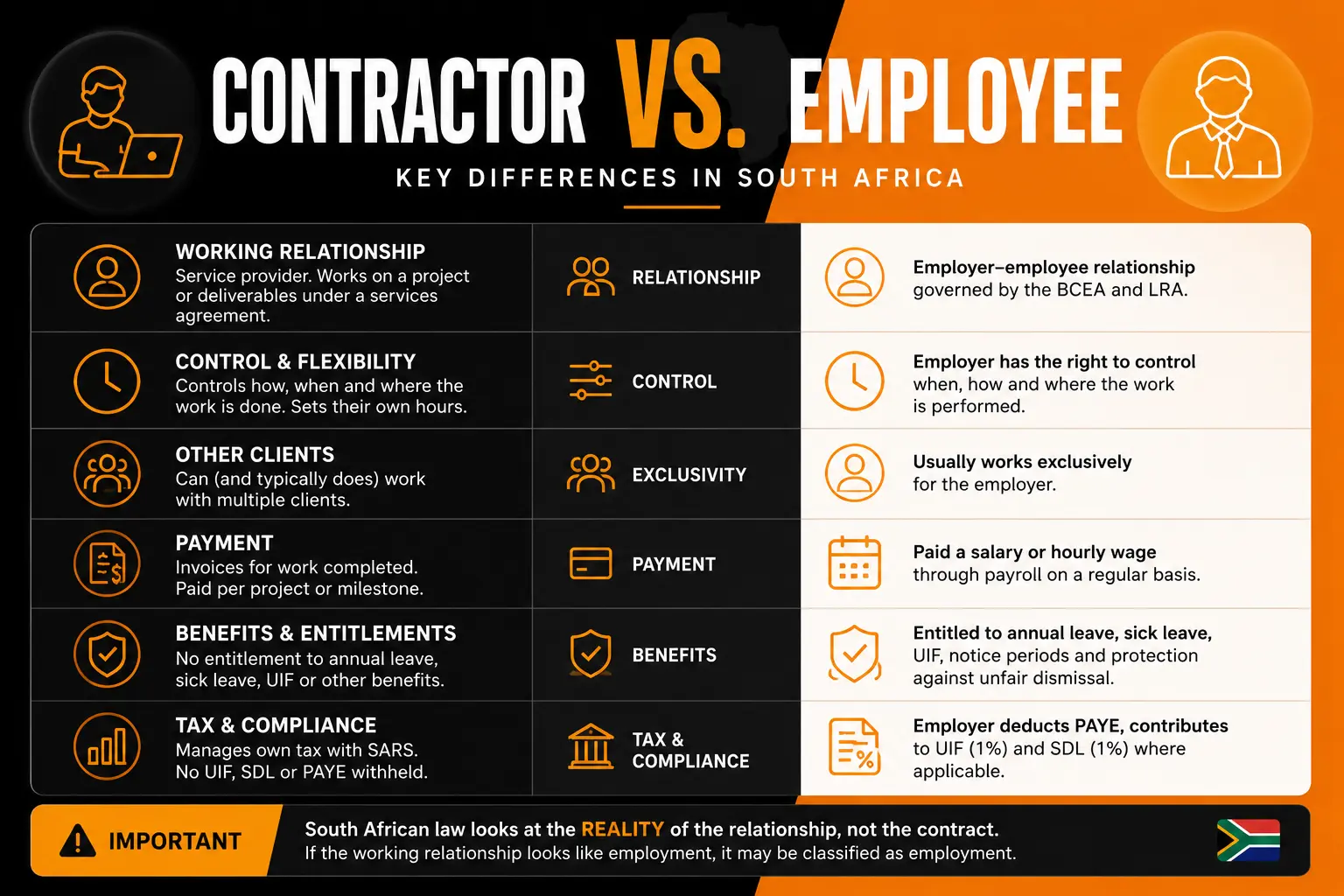
South Africa draws a clear legal distinction between contractors and employees, and the line matters more than most international companies expect.
Under the Basic Conditions of Employment Act (BCEA), an employee is anyone who works for another person in exchange for payment. Employees are entitled to statutory protections including notice periods, annual leave, sick leave, and protection against unfair dismissal.
An independent contractor is someone who performs work for a client under a services agreement, but operates as their own independent business. They control how the work gets done, carry their own business risk, and typically work for more than one client at a time.
When there is a dispute about which category applies, South African courts and the CCMA use what is called the dominant impression test. Rather than looking at what the contract says, they look at the reality of the working relationship.
The key questions are: does the company control when and how the work is done, is the person treated as part of the business, and are they economically dependent on this one client? A contract that says "contractor" means nothing if the day-to-day arrangement looks like employment.
Contractors in South Africa
Independent contracting is a common and legitimate way to hire developers in South Africa, but the arrangement needs to be set up correctly to hold up legally.
How the contractor model works
A contractor works under a services agreement, not an employment contract. They invoice for work completed, handle their own tax through the South African Revenue Service (SARS), and are not entitled to benefits like annual leave, sick leave, or Unemployment Insurance Fund (UIF) contributions.
For international companies, this is usually the fastest way to get started. There is no local entity required, no payroll to set up, and someone can be remotely onboarded within days of signing an agreement.
What you can and cannot do
The contractor model gives you flexibility, but there are limits. You cannot require a contractor to work set hours, attend daily standups, or appear on your organizational chart. You cannot give them a company email address, supply their primary equipment, or stop them from working with other clients.
Do any of these things consistently and the arrangement starts to look like employment.
Cost and tax implications
Contractors manage their own tax: they register as provisional taxpayers with SARS and file twice a year. The hiring company does not deduct PAYE (Pay As You Earn tax), contribute to UIF or Skills Development Levy (SDL), or provide benefits.
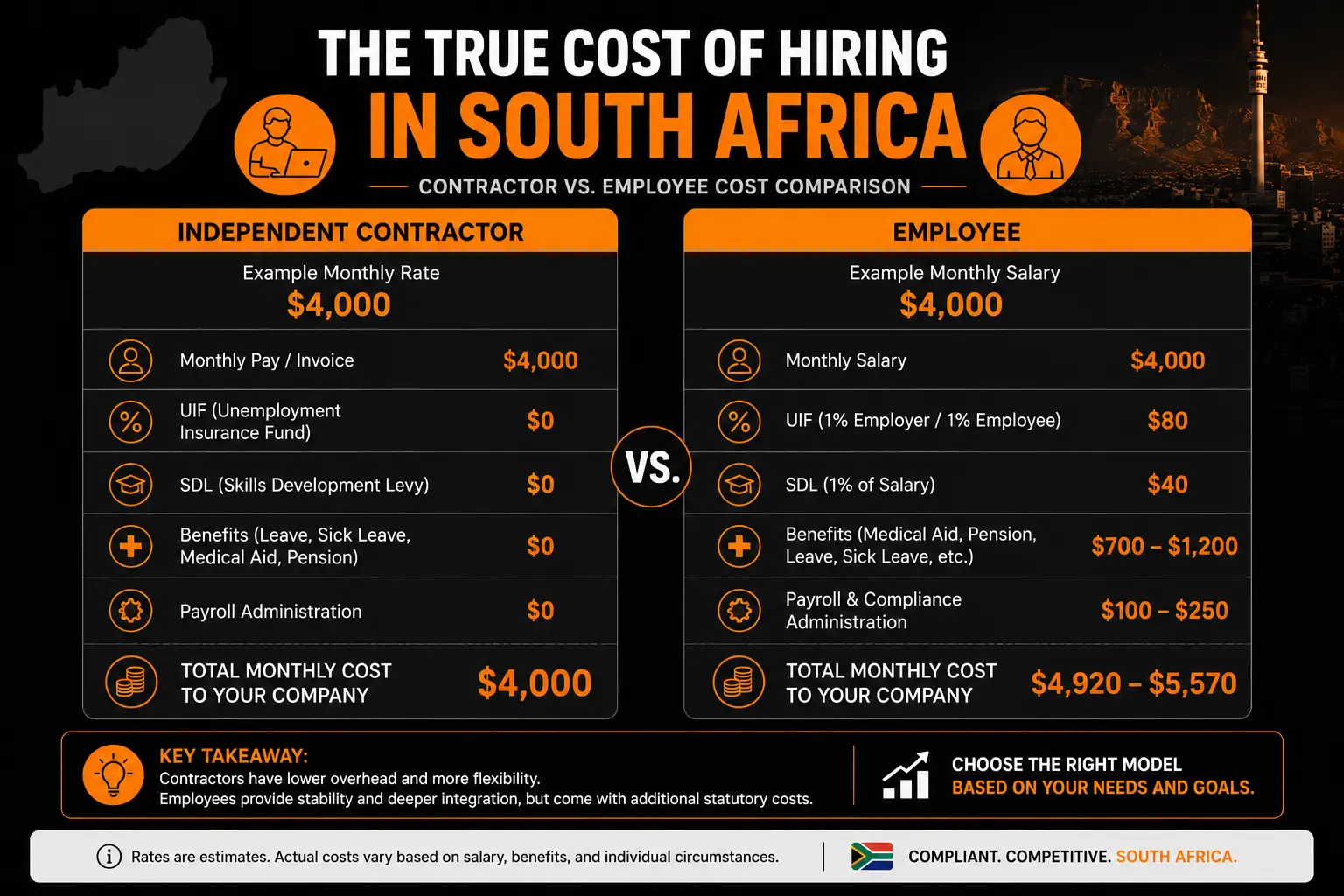
The hourly rate for a contractor is typically higher than an equivalent employee salary, but the total cost to the company is lower because there are no employer contributions or benefit obligations. For short-term or project-based work, this usually makes it the more cost-efficient option.
Employees in South Africa
Hiring a developer as an employee gives you more control and more stability, but it comes with obligations that international companies need to plan for.
Employment rights and obligations
Employees in South Africa are protected under the BCEA and the LRA. As the employer, you need to provide a written employment contract, pay at least the national minimum wage, and contribute 1% of remuneration to UIF.
If your annual wage bill exceeds R500,000, you also pay SDL at 1% of payroll. Employees are entitled to 15 working days of paid annual leave per year, 30 days of paid sick leave per three-year cycle, and protection against unfair dismissal from day one.
Letting someone go is not straightforward either. Dismissal without a valid reason and a fair process can land you at the Commission for Conciliation, Mediation and Arbitration (CCMA), which is costly and time-consuming.
Cost of hiring an employee
The good, old question – how much it costs to hire a developer. Beyond the salary, you are looking at UIF contributions, SDL, and any benefits you offer: medical aid, pension, and device allowances are common in the South African tech market.
Direct hiring also takes longer than engaging a contractor, and without a registered South African entity, you cannot legally employ someone directly.
Onboarding and setup
To hire directly, you need a registered local entity: either a South African company or a branch of your foreign company registered with the Companies and Intellectual Property Commission (CIPC). You will also need to register with SARS as an employer and set up payroll.
For most international companies bringing on their first or second South African developer, that is more overhead than the hire justifies.
How to Choose for Your Tech Hire in South Africa
The right model comes down to the nature of the work and the relationship you want.
Choose a contractor when the work is project-based
If the engagement is time-limited, the scope is defined, and you do not need someone in daily standups or working set hours, a contractor is the right call.
This works best when the developer has other clients, the project is expected to run under six months, and you want to move quickly without setting up any formal employment structure.
Just make sure the arrangement genuinely operates like a contractor relationship, if it starts to look like full-time employment, the classification will not hold.
Choose an employee when you want long-term retention
If the developer is going to be core to your product, works exclusively for you, and integrates into your team day to day, employment is the right structure.
It gives you more control, stronger retention, and a clearer legal relationship. The trade-off is more overhead: you need either a local entity or an Employer of Record (EOR) to employ someone legally in South Africa, and there are statutory obligations to meet from day one.
Consider an EOR when you want a full-time hire without the overhead
If you want all the benefits of a full-time employee but do not want to set up a South African entity, an EOR is the most practical route.
The EOR becomes the legal employer, handles payroll, tax, UIF, and compliance, and the developer works as part of your team day to day. For most international companies hiring their first few South African developers, this is where to start.
Conclusion
The contractor model offers flexibility and lower overhead but carries real classification risk if the arrangement is not structured correctly. Employment gives you compliance and retention but requires more setup and ongoing cost. An EOR gives you the best of both worlds: a full-time, compliant team member without the overhead of setting up a local entity.
Whichever model you choose, getting the structure right from the start is what determines whether your South African hire works long-term.
FAQs
Can a foreign company hire a South African developer as an independent contractor?
Yes. Foreign companies can engage South African developers as independent contractors without needing a local entity. The key is making sure the arrangement actually operates like a contractor relationship: the developer controls how they work, is not exclusively dependent on your company, and is not integrated into your team in a way that resembles employment. If it does not pass the dominant impression test, the classification will not hold.
What happens if I misclassify a contractor as an employee in South Africa?
The consequences can be significant. The developer can refer a dispute to the CCMA, which may rule that they are an employee and entitled to full employment rights, including back pay for leave, UIF contributions, and protection against unfair dismissal. SARS can also hold the hiring company liable for unpaid PAYE and penalties. Misclassification is treated seriously under South African law whether it is deliberate or not.
Do I need to pay UIF and SDL for independent contractors?
No, if the contractor is genuinely classified as an independent contractor and not an employee, UIF (unemployment insurance fund) and SDL (skills development levy) do not apply. UIF contributions (1% employer, 1% employee) and SDL (1% of payroll) are obligations that attach to employment relationships only. If the arrangement is later found to be employment under the dominant impression test, those contributions may be owed retroactively.

Find Your Next Talent
Hire South Africans in Days not Weeks, and only pay after 4 weeks
Or schedule a call with Bojan.