Monolithic vs Microservices: Choose Your Software Architecture - monoliths vs microservices architecture
12 min read


Monolithic Architecture vs Microservices: Which Software Architecture is Right for Your Project?
In modern software development, the initial choice of system software architecture is one of the most critical decisions, directly impacting scalability, agility, and maintenance costs. The debate often centers on two dominant styles: monolithic architecture and microservices architecture. A monolithic application is built as a single, indivisible unit, while a microservices architecture structures an application as a collection of small, independent services. This article provides a comprehensive comparison of monolithic and microservices approaches, detailing the fundamental differences, benefits, and drawbacks of each architectural approach to help you determine which is best suited to your specific business needs and development context. Understanding what's the difference between these two dominant patterns is essential for any modern development team.
What Defines a Monolithic Architecture and a Monolithic Application?
The monolithic architecture is the traditional and most straightforward architectural approach to building an application. It is characterized by a unified codebase and a single deployable unit.
Defining the Monolithic Application
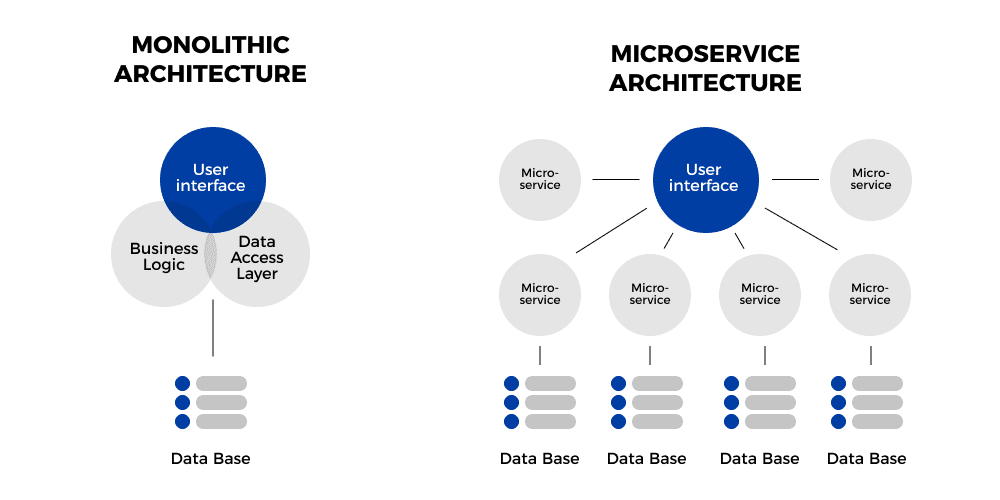
A monolithic application is a single-tiered application where the user interface, business logic, and data access layers are all combined into a single program. All components are tightly coupled and share the same memory space. The structure is often layered, separating the concerns of the user interface from the application logic but remaining within a single monolith codebase. Monolithic architectures are simple to start with, especially for small projects or minimum viable products (MVPs). This simplicity in structure means the initial development team can be small and the setup of the development environment is straightforward.
Advantages of a Monolithic Architecture
The primary advantages of a monolithic architecture include simplicity in initial development, debugging, and deployment. Since the application is built as a single unit, it is easy to debug as all components run in the same process, simplifying stack traces and logging. The entire codebase can be managed by a single team. For smaller applications or a small team, monolithic architecture is often the most cost-effective and fastest way to get a product to market. Furthermore, transactions and security are simpler to manage across the whole application when using a monolithic approach, as there is no need for complex distributed transaction management.
What Defines the Microservices Architecture?
The microservices architecture is the current industry trend, favoring decentralization and independence.
Read our full article on Service-Orientated Architecture vs Microservices
The Foundation of Microservices Architecture
The microservices architecture is an architectural approach that structures a server-side application as a collection of smaller, independent, individual services. Each individual service is built around a specific business logic capability, runs in its own process, and communicates with others, often via lightweight mechanisms such as APIs (Application Programming Interface). Microservices allow organizations to break down complex systems into manageable modular components. Unlike a monolith application, these individual microservices can be developed, tested, and deployed independently.
Benefits of Microservices and Enhanced Scalability
The key advantage of microservices lies in their scalability and technological diversity. Microservices allow teams to independently scale parts of the application that experience high load without scaling the entire application. This fine-grained scaling is highly cost-efficient, especially in cloud-based microservices architecture. Furthermore, microservices provide technological freedom, as each individual service can use the best programming language, database, and technology stack for its specific purpose. This leads to faster development cycles and greater agility in software development.
How Does Deployment and Scaling Differ Between the Two?
The process of updating and growing the application is where the monolithic and microservices architecture exhibit their most significant differences.
The Challenge of Monolithic Deployment and Scaling
In a monolithic architecture, the entire application is packaged as one deployable artifact. To deploy even a minor bug fix or a small update to a single piece of business logic, the entire application must be redeployed. This makes deployment slow and risky, potentially leading to downtime for the whole application. Regarding scaling, a monolithic system can only scale horizontally by running multiple copies of the entire application. If only a small fraction of the monolith is experiencing a high load, the entire resource set of the application is wasted on unnecessary compute resources for the rest of the system.
Efficient Deployment and Scaling with Microservices
The microservices architecture excels in both deployment and scaling. Each individual service is a separate deployable unit. This means deploying microservices updates is fast, isolated, and low-risk, as a failure in one service's deployment does not affect others. The true power lies in scaling. Microservices allow for fine-grained scaling where only the individual service under pressure needs additional compute resources. This highly efficient use of resources and the ability to handle growth without impacting the application as a whole provides far superior scalability compared to a monolithic application.
What is the Impact on Software Development and Agility?
The chosen software architecture deeply influences the speed and efficiency of the development cycles and the structure of the development team.
Monolithic Constraints on Software Development
The size of the monolithic codebase often becomes a major bottleneck in software development. As the monolith grows, onboarding new developers is difficult and time-consuming due to the sheer volume of application code they must understand. Moreover, introducing new features or refactoring core code becomes risky, as a change in one area can unexpectedly break another due to tight coupling. This results in slow development cycles and difficulty in adopting new technologies because the chosen technology stack must be applied across the whole application.
Microservices Enable Modular and Agile Teams
The microservices architecture breaks the system into smaller, modular components, each owned by a dedicated, autonomous development team. This empowers teams to work independently, leading to faster development cycles and quicker release schedules. When developing new features, a team only needs to focus on their individual service, dramatically reducing complexity. Microservices allow for continuous integration and continuous deployment pipelines, enhancing agility and reducing the time-consuming process of large-scale code reviews and unified testing required by the monolithic approach.
How Does Debugging and Observability Compare?
The processes of finding and fixing errors (debug) and monitoring the system differ vastly between the single-process monolithic system and the distributed system of microservices.
Simplicity in Monolithic Debugging
One of the biggest advantages of a monolithic architecture is the ease of tracing requests and debugging. Since the entire application runs within a single process, using standard tools to capture stack traces and logs is simple. All business logic is contained in one place, making it easy to track an issue from the user interface through the application logic to the database. Debugging a monolithic application often requires less sophisticated tooling than a distributed system, saving time and resources for a small team.
The Complexity of Microservices Debugging
In contrast, debugging microservices applications is inherently more complex. A single request may traverse multiple services across different machines, making it difficult to trace the request path and pinpoint the source of an error. This distributed system requires sophisticated tooling for distributed tracing, centralized logging, and advanced monitoring to effectively debug. While this architecture requires a higher initial investment in observability tools, it is necessary to manage the overall complexity of microservices and ensure system reliability.
What Are the Hidden Disadvantages of Microservices?
While the benefits are clear, microservices architecture introduces new challenges, particularly related to operations and networking.
Operational Overhead and Communication Complexity
One of the main disadvantages of microservices is the significant operational overhead. Moving from a single monolith to multiple services requires robust infrastructure orchestration (like Kubernetes or specialized tools) to manage deployment, scaling, and networking for all individual microservices. The communication between multiple services, typically handled via APIs, introduces network latency, and ensuring data consistency across these services can be difficult, often requiring complex patterns like the Saga pattern. Microservices may also increase costs due to the need for more compute resources across various separate instances.
The Drawback of Deployment Complexity
While the advantage of microservices is independent deployment, the overall orchestration of deploying microservices as a whole distributed system is complex. Unlike the simple process of deploying a single monolithic application, deploying a microservices architecture requires careful management of versioning, service discovery, and load balancing. This complexity means that a development team focused on microservices applications must also invest heavily in DevOps practices and automation to avoid the system becoming unmanageable.
How Do Serverless and SOA Relate to Monolithic and Microservices Architecture?
The monolithic and microservices architecture are not the only options; related architectural approaches like SOA (Service-Oriented Architecture) and serverless also factor into the decision.
SOA and the Bridge Between Monolithic and Microservices
SOA (Service-Oriented Architecture) is often viewed as a predecessor or middle ground between a monolithic system and microservices architecture. SOA involves breaking the application into services, similar to microservices, but these services are typically larger (monolithic-like), share more resources, and rely on a central intermediary, often an Enterprise Service Bus (ESB), for communication. While SOA offers some of the benefits of decoupling, the shared ESB can become a single point of failure and bottleneck, a pattern that microservices explicitly avoids.
The Future of Compute: Microservices vs Serverless
Serverless computing is an evolution of the microservices architecture. With serverless, developers write code as functions (often called Functions as a Service or FaaS) without needing to worry about the underlying compute infrastructure or scaling. The cloud provider automatically manages resource provisioning and scaling. This means the serverless approach can dramatically reduce operational overhead compared to a self-managed cloud-based microservices architecture. For many modern microservices applications, adopting serverless is the next logical step in optimizing compute and deployment efficiency. The vs serverless debate is largely an operational one, focusing on management overhead rather than core architecture.
When Should I Choose Monolith Or Microservices?
The choice between monolithic and microservices architecture should be pragmatic and driven by project context, team size, and business growth expectations.
When to Stick with a Monolithic Approach
The monolithic architecture is a traditional software development model that is an excellent choice for applications that are small, simple, or have a contained business logic domain. For a small team or an MVP where speed to market is critical, the simplicity of a monolithic approach saves time and money. If the application requires few third-party integrations, low transactional overhead, and is not expected to experience massive, sudden growth in traffic, choosing the monolith is the safer and more cost-effective option. The simplicity of a monolith architecture helps a small team focus entirely on business logic rather than infrastructure.
When to Moving to Microservices is Justified
The decision for moving to microservices is justified when the system grows into a complex, large-scale distributed system. If the monolithic application is becoming too large to manage, updates are time-consuming, and scaling different parts of the application independently is critical, then the microservices approach is necessary. Furthermore, if the development team is large and organized into smaller, autonomous units, microservices architecture allows them to work independently without stepping on each other's toes. Organizations must understand that microservices introduce significant operational complexity of microservices that must be managed by a mature DevOps culture.
What is the Process of Monolith to Microservices Migration?
Often, businesses start with a monolith and face the challenge of migrating from a monolithic structure when growth demands greater scalability.
The Challenge of Migrating From a Monolithic System
Migrating from a monolithic system is a complex, high-risk process. It typically involves a "Strangler Fig" pattern, where new features are developed as individual services, and gradually, old monolithic functionalities are extracted and replaced by new individual microservices. The challenge lies in managing data consistency, communication between the old monolith and the new microservices, and ensuring that the application as a whole remains stable throughout the transition. This migration to microservices is a long-term strategic project that requires significant planning and resources.
Phased Monolithic Architecture to Microservices Transition
A successful monolithic architecture to microservices transition requires a phased approach. Start by splitting non-core services like logging or monitoring, then extract services that change frequently or require independent scaling. Modular monoliths are an excellent intermediary step, where the monolithic architecture is internally reorganized into modular domains with clear boundaries, even though it remains a single deployment unit. This reorganization prepares the codebase for the external splitting necessary for full microservices architecture adoption.
How Does Monolithic and Microservices Compare on Compute Costs?
The cost of running the application is a practical factor, and monolithic and microservices approaches have different cost profiles.
Compute Efficiency of the Monolithic Approach
Initially, a monolithic architecture is highly compute-efficient. Since the whole application runs in a single process, there is no inter-service communication overhead and minimal resource duplication. A simple monolithic application can run on a single virtual machine with all resources shared efficiently. The cost structure is straightforward: you pay for a few large compute instances.
Cost Dynamics of the Microservices Approach
The microservices approach often involves higher compute costs at scale because each individual service requires its own dedicated resources (CPU, memory, storage). This fragmentation increases the overall consumption of resources. However, this is offset by the fact that microservices typically offer vastly superior scaling efficiency. If only one part of the application is under load, only that part scales, resulting in lower total cost of ownership (TCO) compared to the wasted resources of an over-scaled monolithic system. Furthermore, the adoption of serverless computing within the microservices architecture is rapidly driving down the unit cost of compute.
Summary: Key Takeaways on Monolithic and Microservices
Monolithic architecture is simple, cost-effective, and fast for small applications or small teams, but struggles with scaling and agility as the codebase grows.
Microservices architecture provides superior scalability and technological freedom but introduces significant operational complexity, debugging challenges in a distributed system, and requires specialized infrastructure.
Deployment is a key differentiator: monolithic requires redeploying the entire application for any change, while microservices allow for fast, independent deployment of each individual service.
The decision must be pragmatic: start with a monolith or microservices approach based on current needs, and only undertake the migration to microservices when the complexity of microservices is justified by growth and resource limitations.
Serverless computing is the next step in the microservices vs evolution, offering managed compute and ultra-efficient scaling for microservices applications.

Find Your Next Talent
Hire South Africans in Days not Weeks, and only pay after 4 weeks
Or schedule a call with Bojan.