SOA vs Microservices Architecture: Key Differences
December 14, 2025
8 min read


SOA vs Microservices: Which Architecture is Best for Your Business?
The debate between service-oriented architecture (SOA) and microservices architecture is central to modern software development. Both represent a significant evolution from the limitations of the traditional monolithic architecture, promising greater agility, scalability, and maintainability. While SOA emerged to enable organization-wide reuse and integration, the microservices architecture takes a more decentralized, lean approach, focusing on rapid deployment and independent scaling. This comprehensive guide will explore the key differences between SOA and microservices vs soa, helping you understand what's the difference in their core design principles, communication patterns, and governance models. By the end, you will be equipped to make the critical choice between SOA vs microservices that aligns perfectly with your specific business needs and technical landscape.
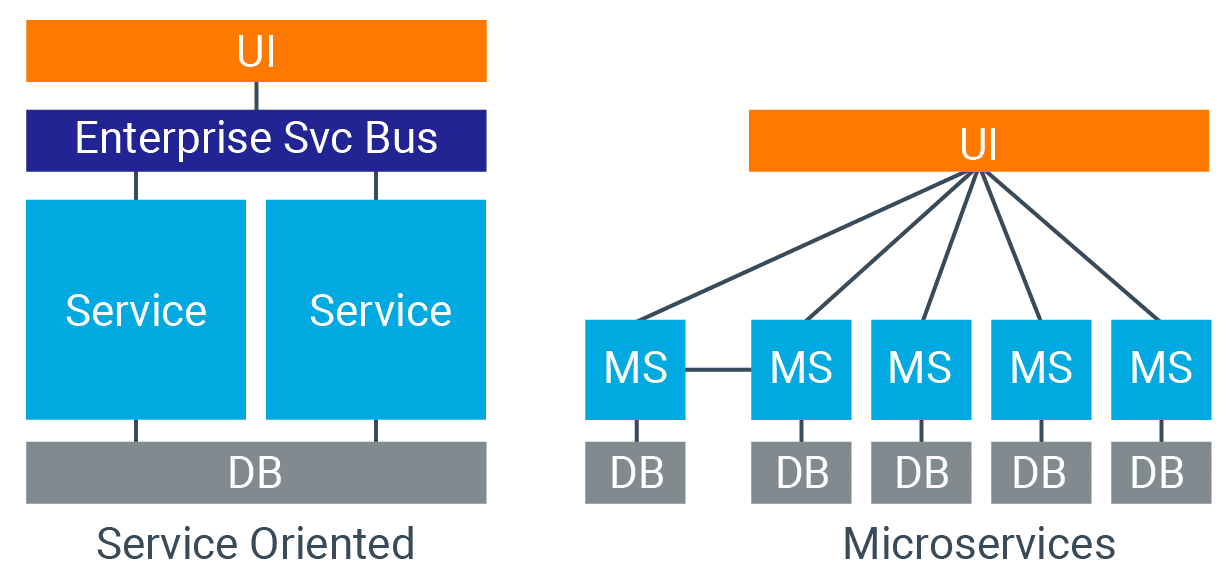
What’s the Difference Between Service-Oriented Architecture and Microservices Architecture?
While both SOA and microservices break down a monolithic application into multiple services, they differ fundamentally in their scope, communication, and governance models.
Defining Service-Oriented Architecture (SOA)
SOA is an architectural style where different applications or systems communicate with each other through formal communication protocols, providing services to one another. The primary goal of SOA is organization-wide reuse of large, coarse-grained soa services to support various business functions across the enterprise. It emphasizes centralized governance and a layered structure. A defining characteristic of a typical soa architecture is the enterprise service bus (ESB), which acts as a central protocol converter, message router, and orchestrator, enabling different services to share resources and communicate, even if they use different technologies. This structure makes SOA powerful for integrating legacy systems but often leads to high coupling and a single point of failure.
Defining Microservices Architecture
The microservices architecture is often viewed as a refinement or evolution of SOA. The core tenet is to structure a complex application as a collection of small, independent, individual services, each running its own process, managed by its own team, and using its own data storage. Microservices are focused on a specific business function or a bounded context. Microservices vs soa is best seen in how the microservices architecture promotes extreme decentralization: there is typically no central ESB or shared governance. Microservices communicate via lightweight mechanisms, commonly restful apis or advanced messaging queuing protocol (AMQP), favoring simple communication protocols over the heavy standards used in SOA.
Read our article on Monolithic vs Microservices Architecture
SOA vs Microservices vs Monolithic Architecture: The Evolution
To fully appreciate the design of SOA and microservices, it is crucial to understand the limitations of the monolithic architecture that they both sought to overcome.
The Pitfalls of the Monolithic Application
A monolithic application is built as a single, unified block. All of its components are tightly coupled and run within a single process. While simple to develop and deploy initially, a monolithic architecture quickly becomes challenging to maintain as the application grows. Even a small code change requires recompiling and redeploying the entire monolithic application, slowing down the development and deployment cycle. Furthermore, if one component and its data demands more resources, the entire application must be scaled, leading to inefficient resource utilization. Both SOA and the microservices architecture offer a remedy to these scalability and agility problems.
SOA as the First Step Towards Decoupling
SOA provided the first widely adopted architectural style to break down the monolithic application into connected services. The services in SOA are large-grained, representing major business functions. The emphasis was on reuse across the enterprise, achieved through standard interfaces, typically using heavy protocols like SOA's favored simple object access protocol (SOAP) or Java Messaging Service (JMS). While successful in promoting reusability and integrating disparate systems, the soa architecture often resulted in services that still had high internal coupling and a heavy dependency on the central ESB, which became the new bottleneck and single point of failure.
The Enterprise Service Bus (ESB): A Main Difference Between SOA
The presence and role of a central intermediary, the enterprise service bus, is arguably the main difference between SOA and microservices architecture.
ESB in the SOA Architecture
The ESB is a core element of classic SOA architecture. It is an expensive, powerful piece of middleware designed to handle message routing, translation, security, and complex orchestration. In SOA, the esb is the backbone that enables multiple services that may use different technologies or protocols to communicate. It simplifies the services themselves by offloading complex integration logic to the central esb. However, this reliance on a centralized enterprise service bus leads to a high coupling between the services and the ESB itself, making soa deployments slow and the system resistant to changes. The central esb also becomes a performance bottleneck and a single point of failure.
Decoupling and Decentralization in Microservices Architecture
Microservices architecture rejects the central ESB approach. Microservices communicate directly with each other, typically using lightweight, simple protocols such as restful apis or asynchronous message brokers. This decentralized communication model is one of the key differences between SOA. Microservices significantly reduce the dependency on a central component, thereby improving the system's resilience and enabling services to be deployed and scaled independently. The philosophy here is that smart endpoints (the microservices) communicate over simple pipes, giving each microservice full control over its own integration logic.
Coupling and Dependency: The Key Differences Between SOA
The level of coupling and dependency between services and infrastructure is critical in determining the agility and scalability of the architecture.
Coarse-Grained Coupling in SOA
SOA services tend to be large, coarse-grained, and often share resources like a single data storage layer and the central esb. This results in what is often termed high technical coupling and dependency. For instance, an upgrade to the central enterprise service bus or changes to the shared schema can impact every soa architecture service. While promoting organizational reuse, the large service granularity of services in soa means they are slower to change and harder to scale individually. The centralized governance model exacerbates this, as changes require coordination across the entire enterprise.
Loosely Coupled Independent Services
The microservices architecture is defined by its focus on small, independent services that are loosely coupled. Each microservice is built around a bounded context, owns its component and its data, and can be developed, tested, and deployed completely independently of others. This independent nature of microservices minimizes dependency and technical coupling. Microservices embrace simplicity in communication, favoring point-to-point apis over a heavy middleware. This extreme level of independence is what gives microservices offering superior agility and resilience compared to soa architecture.
Data Storage and Governance: What are the Differences Between Microservices?
How data is managed and how the development process is governed represent another critical area of divergence between the two architectural styles.
Centralized Data Governance in SOA
In classic SOA, it is common for soa applications to share a common and often complex central data storage layer, usually a large relational database. While this enforces consistent data governance and simplifies transaction management across different services, it creates a high level of coupling. Any schema change requires coordination across all consuming soa services, undermining independent deployment. Furthermore, the centralized approach to governance means standards, security policies, and documentation are mandated from a central authority, enforced via the central esb.
Decentralized Data Storage in Microservices
Microservices architecture mandates that each microservice should own its data and use its own dedicated data storage (e.g., a service might use a relational database, another a NoSQL store). This is crucial for maintaining the independent nature of microservices and their ability to be deployed independently. Microservices does not enable a single data storage layer for sharing. Governance is also decentralized; while standards exist, teams have autonomy over their specific technology stack, protocol, and internal architecture, as long as they adhere to the external apis. This level of freedom is a key reason why microservices provide better speed and flexibility.
Reuse and Service Granularity: How Do SOA and Microservices Differ?
The philosophy of reuse is a primary distinction, impacting how services are designed and defined in both SOA and microservices architecture.
Enterprise Reuse in SOA
SOA was designed with enterprise-wide reusability as a core mandate. SOA services are generally coarse-grained, representing major business functions like "Customer Management" or "Order Processing." The intent is for other parts of the organization to access and reuse these large services via the ESB. While this promotes organizational-level component sharing, it often leads to services that are too large and complex, reducing the overall agility and increasing the dependency load on the esb and the shared data storage. The focus is on the technology of service exposure rather than the business capabilities.
Capability-Focused Microservice Reuse
Microservices architecture prioritizes domain-driven design and service granularity. Each microservice is small, highly focused, and aligned with a specific business capability or bounded context. Reuse is often achieved through composing these smaller microservices or through well-defined, public apis. While there is less emphasis on organizational reuse compared to SOA, the benefit is that each microservice is easier to maintain, faster to deploy, and much more focused on its specific business requirement, leading to greater agility. Whereas microservices focus on capability, SOA involves a heavier central layer for shared logic and communication.
Use Case: When Should You Use SOA and When is Microservices Architecture Better?
The optimal choice of architectural style depends entirely on the context, scale, and requirements of the project.
When to Use SOA
You should consider SOA if your primary goal is to integrate a large number of existing, diverse, or legacy systems across a broad enterprise scope. If your organization requires a high degree of governance and centralized control over integration standards, and you can tolerate slower development and deployment cycles, SOA can be a valid option. A classic use case for SOA is in large financial institutions or government agencies that need to orchestrate communication between dozens of disparate systems that share a common business function, often relying on legacy protocols that need to be converted by the centralized enterprise service bus.
When Microservices Architecture is Best
Microservices architecture is the superior choice for building new, large-scale, distributed systems that require high scalability, rapid deployment frequency, and technology diversity. If your application needs to operate in a cloud or hybrid cloud environment, if teams need to be autonomous, and if individual parts of the application need to scale independently, microservices architecture is best. The microservice approach is ideal for consumer-facing complex applications, e-commerce platforms, or any scenario where agility and resilience are paramount. The independent services and decentralized governance allow for unmatched speed in software development.
Development and Deployment: A Tale of Two Architectures
The operational aspects of building, testing, and releasing software are starkly different between the two architectures.
Heavy Lifecycles in SOA
Due to the central ESB and the high dependency among services and shared data storage, soa deployments are often complex, requiring coordination across many teams and systems. The central governance structure, while ensuring consistency, slows down the process. Testing is also complex because the large-grained soa services have many internal dependency links, and testing often requires deploying the entire service chain. This heavy lifecycle is a major contributor to the slower agility and resilience of SOA.
Autonomous Lifecycles in Microservices
Microservices provide autonomous development and deployment lifecycles. Because each microservice is small, owns its own data, and is loosely coupled, teams can write, test, and deploy their microservice without needing approval or coordination from others, as long as the public-facing api contract is maintained. This enables continuous delivery and integration pipelines for each microservice, dramatically speeding up time-to-market. The independent deployment, often into a cloud environment, is a defining feature of the microservices architecture that makes it ideal for achieving high agility and resilience.
Service Granularity: How Small is Too Small for a Microservice?
The size of the service is a conceptual difference between SOA and the independent services of the microservices architecture.
Coarse Service Granularity in SOA
SOA focuses on coarse service granularity—services that group together a broad set of related capabilities, essentially representing a major business function. For example, a "Billing Service" might handle everything from invoicing to payment processing to debt collection. This large size is intentional, facilitating component sharing and reuse across the enterprise scope. However, it means that a change to one small aspect of billing necessitates changes and redeployments to the entire, large SOA service.
Fine Service Granularity in Microservices
The nature of microservices dictates that they should be small, focusing on a single, specific business function or a bounded context. A billing system might be broken down into separate microservices for "Invoice Generation," "Payment Gateway Interaction," and "Billing History." This fine service granularity is what enables a microservice to be developed and scaled independently. While this increases the number of services, it significantly lowers coupling, making the system as a whole more resilient and easier to manage, as the complexity is moved from the service itself into the communication layer.
Summary: SOA vs Microservices - The Ultimate Takeaways
SOA is an architectural style focused on large-scale reuse and integration across an enterprise scope, often relying on a central enterprise service bus (ESB) for communication and governance.
Microservices architecture is a decentralized approach focusing on small, independent services that own their own data storage, communicate via lightweight protocols (APIs), and are deployed autonomously.
The main difference between SOA and microservices architecture is the ESB vs. point-to-point communication, and centralized governance vs. decentralized governance.
SOA services are coarse-grained, leading to higher coupling and dependency, which slows down development and deployment.
Microservices are fine-grained and loosely coupled, resulting in high agility and resilience but requiring more complex distributed systems management.
Use SOA for integrating legacy systems and when centralized control is a must; microservices vs soa is best for new, cloud-native applications requiring independent scaling and rapid delivery.

Find Your Next Talent
Hire South Africans in Days not Weeks, and only pay after 4 weeks
Or schedule a call with Bojan.