Pros and Cons of Hiring South African Developers: What to Expect
6 min read


Hiring developers in South Africa is a quite significant remote hiring decision a tech company can make. You are committing to a hiring structure, a legal framework, and a working relationship that will shape how your team operates day to day. Getting that decision right matters.
This article covers both points, so you can decide whether it is the right move for your team before you commit to anything.
Key Takeaways
Cost: Remote developer rates in South Africa run 35–60% below equivalent US and EU hires across most roles and seniority levels.
Risk: The single biggest operational risk is time-to-hire for specialist roles like DevOps and Data Engineering, where supply is tight and searches routinely take longer than for Frontend or Backend roles.
Time zone: South Africa runs on SAST (UTC+2) year-round with no daylight saving, giving UK and EU teams near-full working day overlap.
Why Companies Consider South Africa
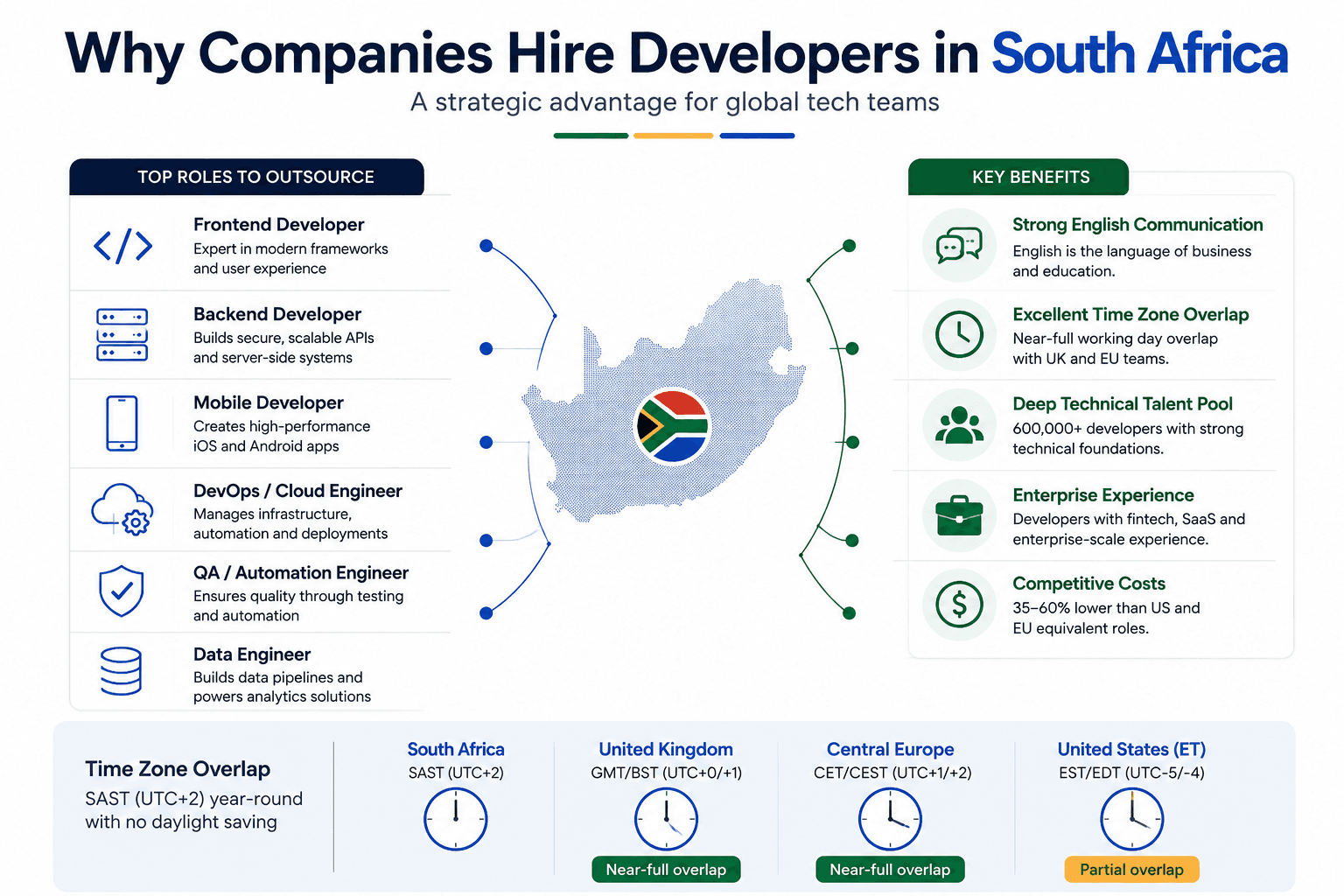
South Africa has built a reputation as a remote hiring market for a few reasons that hold up across company sizes and role types.
The first one is language. English is not a business skill developers have acquired. It is the language they were educated in, work in, and think in. That removes a layer of potential communication gap that shows up in other outsourcing markets more than people expect.
South Africa's fintech and banking sector is one of the most technically demanding on the continent, home to companies like Discovery, Naspers, TymeBank, and Yoco. Developers coming out of these environments have dealt with compliance requirements, high-volume transaction systems, and enterprise-scale architecture. That kind of experience is not universal in offshore markets at this price point.
South Africa runs on SAST (UTC+2) with no daylight saving, which means South African developers share near-full working day overlap with UK and EU teams year-round, with no seasonal drift.
The Pros of Hiring South African Developers
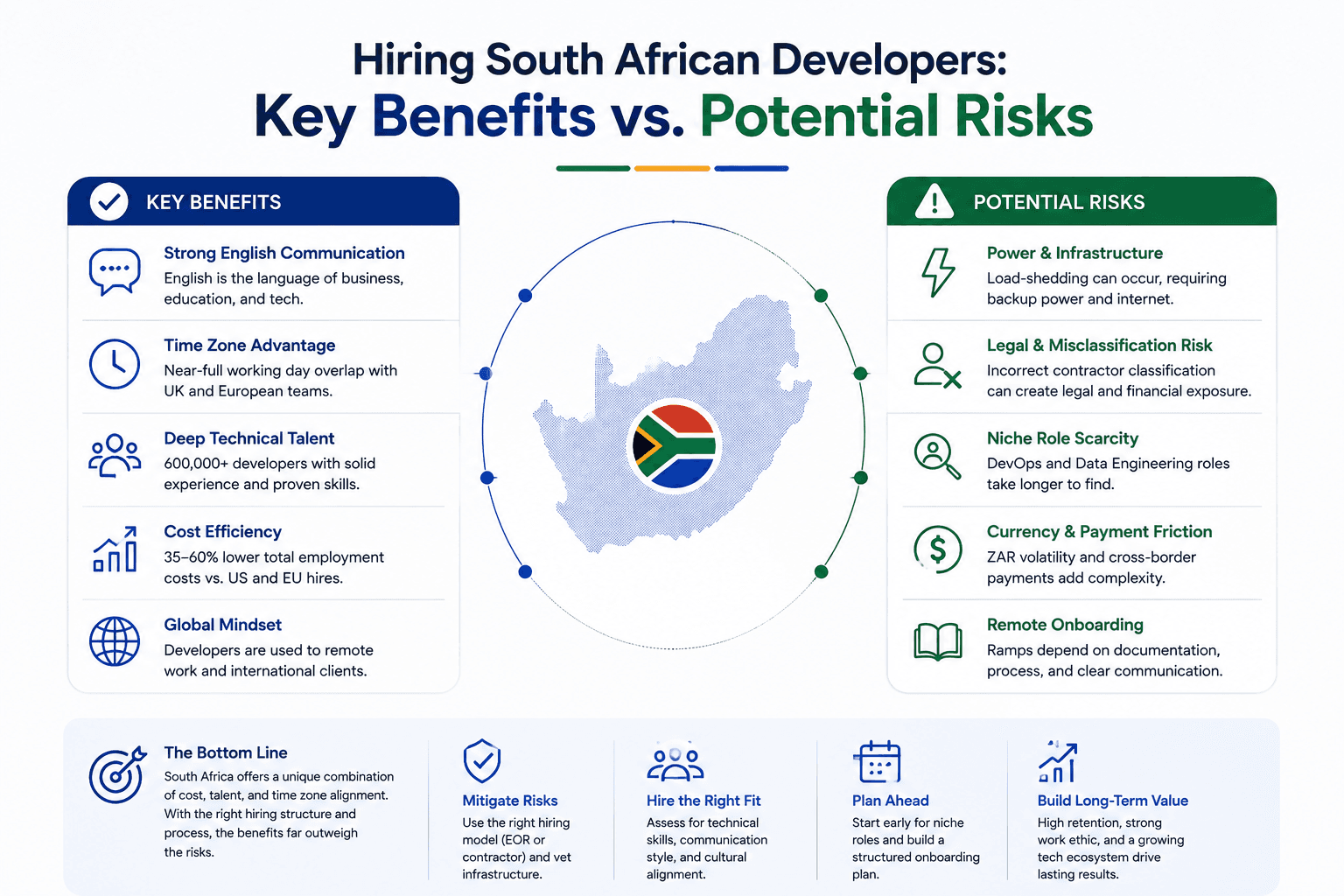
These are the advantages that hold up under scrutiny, not just the ones that look good in a pitch deck.
Cost savings
Remote developer rates in South Africa run 35-60% below equivalent US and EU hires at the same seniority level, and the gap shows up across different roles: Frontend and QA at the cost-efficient end, and DevOps and Data Engineering at the premium end.
The developer rates in South Africa by role and seniority also hold up over the long term, partly because retention rates here are significantly higher than in markets like India, where attrition averages far less annually.
Time zone overlap
South Africa sits at UTC+2 year-round with no daylight saving. For UK and EU teams that means a near-full working day of live overlap, in every season.
US East Coast teams get a workable morning window for standups and check-ins. Neither Asia nor LATAM can offer the same overlap for European companies, which means most collaboration with those regions defaults to async by necessity.
English fluency and communication quality
English is the first language of business in South Africa, not a second language developers have learned for work. The communication style is direct and familiar to UK, EU, and US product teams, which means requirements land as intended, feedback is acted on clearly, and there is no language friction slowing the loop down.
Deep and growing talent pool
South Africa has over 600,000 developers, with the pool growing year-on-year. The strongest supply is in Frontend, Backend, and Full-Stack roles, with solid depth in Mobile and QA as well. Universities produce thousands of new graduates annually, and the country's established fintech and SaaS sector means mid and senior level talent has real production experience, not just academic credentials.
Cultural and work-style alignment
South African developers are used to agile workflows, remote team structures, and working directly with international clients. The expectations around responsiveness, documentation, and delivery are already familiar on both sides. There is no real adjustment period.
The Cons of Hiring South African Developers (and How to Mitigate Them)
These are the real trade-offs. Each one is paired with how experienced hirers actually handle it.
Load-shedding and power infrastructure
Load-shedding is the first objection most companies raise. South Africa has experienced scheduled power outages in recent years, and while the situation has improved substantially, the concern is understandable.
The reality for professional developers working with international clients is that backup power, inverters, fibre connections, and LTE failover are standard practice, not exceptions. For a properly vetted hire or a credible agency placement, this is a solved problem. Ask about home office setup during screening and it stops being a risk.
Legal and misclassification risk
South African labour law is more employee-protective than US law and sits closer to European standards. Engaging a developer as an independent contractor when the working arrangement looks like employment creates real legal and financial exposure under the Basic Conditions of Employment Act (BCEA) and the Labour Relations Act (LRA).
The fix is using the right structure from the start: either a genuine contractor arrangement that holds up under scrutiny, or an Employer of Record (EOR), where a third party employs the developer locally and handles all compliance on your behalf.
The contractor vs employee distinction under South African law is worth understanding before you make any hire here. The risk is not in the market, it is in how the engagement is structured.
Niche-role scarcity and longer time-to-hire
For Frontend, Backend, and QA roles, South Africa has deep supply and searches move quickly. For DevOps, Cloud, and Data Engineering, the picture is different. Demand has outpaced supply in these specialisations, and time-to-hire is meaningfully longer.
Companies that treat a DevOps search like a Frontend search regularly end up with extended vacancies and missed timelines. The mitigation is simple: start the search earlier for scarce roles, widen the sourcing funnel beyond LinkedIn, and work with a partner who has an existing talent community in these specialisations.
Currency and payment friction
The South African rand (ZAR) is a volatile currency, which means what developers earn in real terms can shift significantly depending on exchange rates. When the rand weakens, it can create retention pressure on the developer's side. On the employer side, ad hoc cross-border payments and invoicing add administrative overhead and occasional delays.
Both issues are resolved by using an EOR or international payment platform built for this rather than informal wire transfers.
Onboarding distance
Since there is no in-person option, you need to focus on onboarding the remote South African hire. That means ramp-up depends more heavily on async documentation, structured onboarding, and a deliberate first-30-days plan than a local hire would require.
Companies that treat the onboarding process as they would a local hire, assuming context will transfer naturally and proximity will fill the gaps, tend to have slower ramps. The mitigation is planning for remote onboarding explicitly: a written brief, clear first-week tasks, a defined check-in cadence, and access to the right tooling from day one.
Weighing the Trade-offs: When South Africa Is (and Is Not) the Right Fit
South Africa is not the right answer for every company or every hire. Here is how to tell the difference.
South Africa is a strong fit when you are a cost-sensitive scale-up looking to hire Backend or Frontend developers at mid or senior level, you need developers who can work during UK or EU business hours without significant async lag, or you are building a distributed team and want English-first communication without the cultural adjustment period that comes with some other outsourcing regions.
South Africa is also a strong fit when you have an existing distributed team that already runs well remotely, uses structured onboarding, and has the documentation in place to ramp someone without relying on in-person proximity.
Reconsider or plan carefully when you need a senior DevOps or Data Engineering hire within a week or two, with no flexibility on timeline. That is not a realistic expectation in this market for those specialisations, and forcing it will lead to a poor hire or an extended vacancy.
Also plan carefully when you are not willing or able to use a contractor or EOR structure for a full-time hire. Trying to run what is functionally an employment relationship through an informal contractor arrangement creates legal exposure that grows over time.
If the structure is not right, the market advantages do not matter. The common hiring mistakes in South Africa almost always come back to structure and speed.
Why Companies Choose to Hire Through Us
We have placed developers across all major technical specialisations for companies in the UK, EU, and US. A few numbers that reflect how that process works in practice:
68 hours average time-to-fill from brief to shortlist
35–60% savings vs. equivalent Europe and US hires
90% retention after 18 months
4-week risk-free trial: no payment if you are not satisfied
We screen for communication style and cultural fit alongside technical skill, because a developer who codes well but cannot integrate into a distributed team is not a useful hire.
Is South Africa the Right Market for Your Situation?
The honest answer is: it depends on your role, your timeline, and how you structure the engagement. For most companies hiring Backend, Frontend, or QA developers who need UK or EU hours, the case is strong and the trade-offs are manageable. For niche specialist roles on a tight timeline, the picture is more nuanced.
If you want to talk through your specific situation: the role, the timeline, and the right hiring structure for your context, get in touch and we will give you a straight answer on whether South Africa is the right fit and how to approach it if it is.
FAQs
What are the biggest risks of hiring developers in South Africa?
The two most significant risks are misclassification and niche-role time-to-hire. Misclassification happens when a full-time developer is engaged as an independent contractor but the working arrangement looks like employment under South African law. The fix is using a contractor or EOR structure that is set up correctly from the start. Niche-role scarcity applies mainly to DevOps, Cloud, and Data Engineering, where demand has outpaced supply. The mitigation is starting the search earlier and working with a partner who has an active talent community in those specialisations, not just a LinkedIn search.
Is South Africa cheaper than hiring in Eastern Europe or Latin America?
Directionally, South Africa sits at a competitive rate point relative to both regions, particularly at senior level. Eastern Europe has seen rates rise significantly as EU integration has pushed senior developer costs higher. LATAM has strong demand from US companies, which has pushed rates up in markets like Brazil and Mexico. South Africa's advantage is not purely cost: it combines competitive rates with first-language English and near-full UK and EU time zone overlap, which neither Eastern Europe nor LATAM can match simultaneously. For exact comparative figures, verify current rate benchmarks across regions before making a direct comparison, as these figures shift year to year.
Do South African developers deal with load-shedding, and does it affect delivery?
Yes, load-shedding has been a real issue in South Africa, though the situation has improved substantially since 2023. For professional developers working with international companies, backup power, inverters, and fibre with LTE failover are standard practice. It is a solved operational problem for a properly vetted hire, not a live delivery risk. During screening, ask any candidate directly about their home office setup. A developer who cannot answer that question clearly is a red flag regardless of load-shedding.

Find Your Next Talent
Hire South Africans in Days not Weeks, and only pay after 4 weeks
Or schedule a call with Bojan.