Software Developer Salary Trends in South Africa for 2026
8 min read


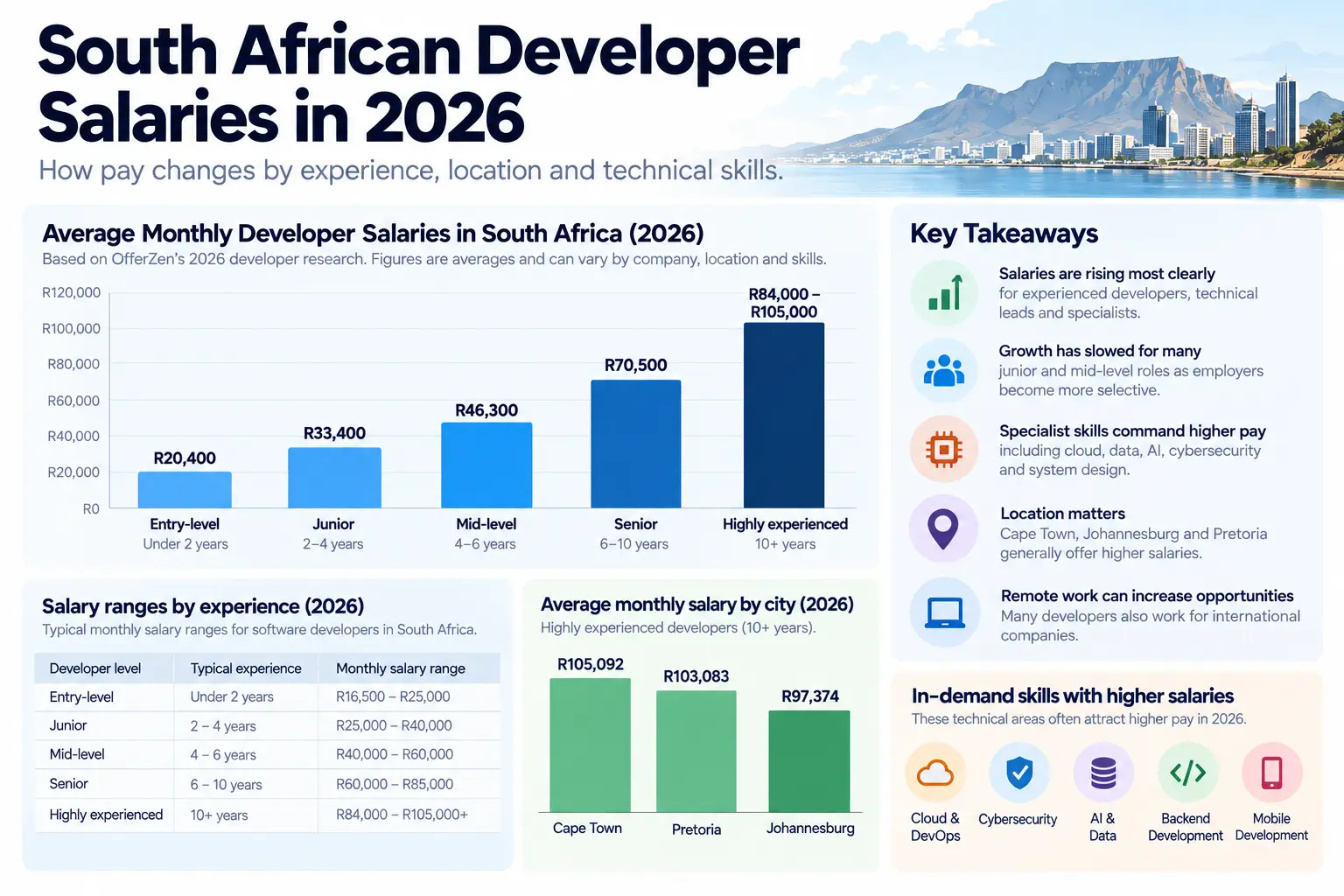
Software developer salaries in South Africa are changing, but not at the same rate across the market.
Pay is rising most clearly for experienced developers, technical leads, and specialists. At the same time, salary growth has slowed for many junior and mid-level roles. Employers are becoming more selective, while developers with strong cloud, data, AI, cybersecurity, and system-design skills remain difficult to replace.
Location, experience, technical specialisation, and employer type also affect what a developer can earn. Someone working remotely for an international company may have different salary expectations from a developer doing similar work for a local business.
Why Software Developer Salaries Are Changing in South Africa
South Africa’s technology market is becoming more selective. Companies still need experienced technical professionals, but many are keeping teams smaller and expecting each developer to take on more responsibility.
AI is also changing the skills employers value. Basic coding tasks are becoming easier to automate, while system design, product knowledge, technical judgement, and project oversight are becoming more important. OfferZen’s 2026 research found that 36% of developers believe AI has improved their earning potential. Another 44% have spent time learning or using AI tools to remain competitive.
Demand is still strong for several technical roles. The MICT SETA’s 2025-2030 Sector Skills Plan includes software developers, ICT security specialists, developer programmers, data scientists, systems analysts, and network engineers among its priority occupations.
Competition is especially strong for professionals who combine technical expertise with good communication, leadership, and business knowledge. These developers can often choose between local businesses, South African technology companies, and international employers offering remote work.
Things You Need to Know About Software Developer Salary Trends in South Africa
A national average cannot show the full market. Salaries differ by experience, job title, industry, city, company size, and technical stack. The following benchmarks provide a useful starting point, but individual offers may fall above or below them.
Developer Salaries at a Glance
The table uses selected 2026 salary averages reported from OfferZen’s South African developer research. Annual amounts are calculated from the monthly figures and rounded. These are cost-to-company salary benchmarks before tax, not contractor rates or total employer costs.
Developer level | Typical experience | Average monthly salary | Approximate annual salary | Useful 2026 benchmark range |
Entry-level | Under 2 years | Around R20,400 | Around R245,000 | R16,500-R25,000 per month |
Junior | 2-4 years | Around R33,400 | Around R401,000 | R25,000-R40,000 per month |
Mid-level | 4-6 years | Around R46,300 | Around R555,000 | R40,000-R60,000 per month |
Senior | 6-10 years | Around R70,500 | Around R847,000 | R60,000-R85,000 per month |
Highly experienced | 10+ years | Around R84,000-R105,000 | Around R1.01-R1.26 million | R84,000-R105,000+ per month |
The ranges are broad because a general web developer, a senior backend engineer, and a cloud architect may have very different salaries even when they have similar years of experience.
Pnet’s salary research provides another useful view of the market. Its salary guides are based on offers from thousands of vacancies rather than employee surveys. The company notes that experience, location, and specialist skills can all move a salary away from the national average.
How Developer Salaries Have Changed
The rapid salary increases seen earlier in the decade are beginning to slow.
OfferZen’s 2026 findings show that salaries have become more stable across much of the technology market. Experienced developers continue to see stronger salary growth, while some entry-level roles are under pressure. More than a third of surveyed developers received increases of between 4% and 6%. This suggests that normal, inflation-linked raises are becoming more common than large double-digit increases.
The gap between experience levels is also becoming clearer. In Cape Town, the average monthly salary for a developer with more than ten years of experience increased from R100,128 in 2025 to R105,092 in 2026. By comparison, the average salary for an entry-level SaaS developer fell from R21,621 to R16,470.
International remote work also affects salary expectations. Developers who can work with overseas teams may compare local offers with salaries from UK, European, or US companies. South African employers may not need to match those salaries, but they may need to offer flexible working arrangements, useful benefits, career development, or more interesting technical work.
How Salaries Differ by Experience
Junior developers usually need more training, code reviews, and support from experienced team members. This often means they start on lower salaries, especially as AI tools can now handle some of the simpler coding tasks that were previously given to entry-level developers.
Mid-level developers become more valuable when they can complete features independently, work confidently with live systems, and make technical decisions without regular supervision. Their salaries may increase further when they have experience with cloud platforms, software testing, security, or products used directly by customers.
Senior developers are paid for much more than their coding ability. They may design systems, review technical architecture, mentor junior team members, reduce technical risks, and work closely with product managers or business leaders. Employers are usually willing to pay more for developers who combine strong technical skills with sound judgement and the ability to work independently.
Businesses should therefore set budgets according to the responsibilities of the role, not only the job title. When calculating the full cost of hiring a developer in South Africa, employers should include benefits, recruitment fees, equipment, payroll administration, and other expenses alongside the base salary.
Which Developer Skills Command Higher Salaries?
Developers normally earn more when their skills are both valuable and difficult to replace.
Cloud and DevOps professionals can earn higher salaries because they manage important parts of a company’s technical environment. Their work often includes infrastructure, software deployment, system performance, reliability, and security. Experience with AWS, Microsoft Azure, Google Cloud, Kubernetes, and automated deployment tools can make a developer more valuable to employers.
Cybersecurity skills are also becoming more important as companies deal with stricter compliance rules and more advanced security threats. Security engineers, cloud security specialists, and developers who know how to build secure software may receive better offers because their work helps protect systems, customer data, and business operations.
AI, machine learning, and data engineering are also growing areas. However, employers usually want more than a basic understanding of AI tools. Developers who can build reliable systems, prepare and manage data pipelines, measure how well models perform, or add AI features to existing products safely can often earn higher salaries.
Experienced backend and full-stack developers remain in strong demand as well. Employers value professionals who understand scalable systems, databases, APIs, software testing, and cloud platforms. Mobile developers may also attract higher salaries when they have a proven record of building reliable iOS, Android, or cross-platform applications.
Location and Remote Work Can Affect Developer Salaries
Cape Town, Johannesburg, and Pretoria remain South Africa’s main technology employment centres, but developers do not earn the same salaries in every city.
Cape Town generally offers the highest salaries for senior developers. In 2026, developers with more than ten years of experience earned an average of R105,092 per month in the city.
Pretoria followed closely, with highly experienced developers earning an average of R103,083 per month. The equivalent average in Johannesburg was R97,374. However, Johannesburg has a large corporate, financial-services, and enterprise technology sector, so some developers may still earn well above the city average.
Remote work has made location less important, but it has not removed regional salary differences. Some employers still adjust salaries according to where the developer lives, while others use the same salary range across South Africa. International companies may also set salaries in a foreign currency or compare South African developers with candidates from other countries.
After a candidate accepts an offer, employers should follow a clear remote employee onboarding process. Good onboarding can help the developer settle into the role, become productive sooner, and feel more connected to the wider team.
What Do These Salary Trends Mean for Employers?
Employers should start with a realistic salary range based on the developer’s experience, responsibilities, and technical skills. Using one broad range for junior, mid-level, and senior candidates can attract the wrong applicants and make salary discussions more difficult later.
The full compensation package also matters. Performance bonuses, retirement contributions, medical aid, flexible working hours, learning budgets, paid leave, and support for remote work can make an offer more attractive. OfferZen reports that only 34% of developers believe their current benefits meet their needs, so a useful package can help an employer stand out.
Salary benchmarks should be reviewed regularly as well. An offer that was competitive two years ago may no longer attract the same quality of candidate. This is especially true for senior developers and professionals with cloud, security, data, or other specialist skills.
Employers should also move quickly when they find a strong candidate. Clear job requirements, well-planned interviews, and fast feedback reduce the risk of losing that person to another company. Following a structured process for hiring software developers in South Africa can make it easier to identify suitable candidates and keep the recruitment process moving.
Conclusion
Software developer salaries in South Africa are becoming more stable, but salary trends still differ across experience levels and technical roles.
Junior developers are entering a more competitive job market, while experienced developers and technical specialists continue to receive stronger offers. Skills in cloud engineering, DevOps, cybersecurity, AI, data, backend development, and technical leadership can lead to higher salaries because these professionals are more difficult to find and replace.
Employers should avoid using one national salary average for every vacancy. A competitive offer needs to reflect the responsibilities of the role, the skills required, the developer’s location, the benefits included, and how independently the person will be expected to work.
Companies that review salary benchmarks regularly, keep their recruitment process moving, and offer a competitive overall package will have a better chance of attracting experienced South African developers and keeping them for the long term.
FAQs
What is the average software developer salary in South Africa?
Salary depends on experience and specialisation. Selected 2026 benchmarks range from around R20,400 per month for entry-level developers to between R84,000 and R105,000 per month for developers with more than ten years of experience.
How much does a senior software developer earn in South Africa?
A developer with six to ten years of experience may earn around R60,000-R85,000 per month. Developers with more than ten years of experience can earn R84,000-R105,000 or more, depending on their location, skills, and responsibilities.
Are software developer salaries increasing in South Africa?
Salaries are increasing for many experienced developers, but growth has slowed across the wider market. Senior professionals continue to see some of the strongest increases, while entry-level salaries are more mixed and have fallen in some industries.

Find Your Next Talent
Hire South Africans in Days not Weeks, and only pay after 4 weeks
Or schedule a call with Bojan.