South Africa vs Latin America for Developers: A Hiring Comparison
8 min read


Key takeaways
South Africa and Latin America both offer experienced developers at more competitive costs than many hiring markets in the US, UK, and Western Europe.
Latin America gives employers access to a large talent pool across several countries. It is particularly convenient for US and Canadian companies because of the strong overlap with North American working hours.
South Africa can be a better fit for UK and European businesses that need English-speaking developers to work closely with their existing teams throughout the day.
Latin America is not one hiring market. Salaries, employer costs, language skills, and employment rules vary between Brazil, Mexico, Argentina, Colombia, Chile, and other countries in the region.
Cost is most commonly the starting point when companies compare locations for remote developers, but it is not the only factor that matters.
South Africa and Latin America both offer skilled developers across software engineering, cloud, data, DevOps, cybersecurity, and mobile development. Many have experience working with international teams.
Latin America provides access to several large technology markets and works particularly well for US and Canadian companies because of its time zones. South Africa has a smaller talent pool, but its working hours align closely with the UK and Europe. English communication can also make it easier for developers to join an existing team.
The right choice depends on cost, available skills, working-hour overlap, and how closely developers need to collaborate with the wider business.
Why Companies Compare South Africa and Latin America for Developer Hiring
Both regions can provide meaningful savings compared with hiring developers in London, New York, San Francisco, or other expensive technology centres.
Latin America has the advantage of scale. The region includes major technology markets such as Brazil, Mexico, Argentina, Colombia, and Chile, as well as smaller but established talent hubs in Uruguay, Costa Rica, and other countries. In late 2025, approximately 16 million developers from Latin America were using GitHub, with Brazil becoming the platform’s fourth-largest developer community worldwide.
This offers many locations to consider, but it also makes the hiring process more complicated. A developer in Mexico City will not have the same salary expectations, employment rules, or language background as a developer in Buenos Aires, Bogotá, Santiago, or São Paulo.
South Africa has a smaller talent pool, mainly centred around Johannesburg, Cape Town, Pretoria, and Durban. However, it is one national market, which can make salaries, employment requirements, and hiring conditions easier to compare. Companies considering hiring developers from South Africa should still research the local market and decide whether it matches their technical and business needs.
Things You Need to Know About South Africa vs Latin America for Developers
A useful comparison needs to look beyond a single regional average. Seniority, location, technical specialisation, contract type, employer contributions, and competition for talent can all change the final cost. The following figures provide a starting point before these differences are considered in more detail.
Developer Costs at a Glance
These are market benchmarks rather than fixed hiring prices. The South African figures below refer mainly to local monthly salaries, while the Latin American figures combine remote salary and contractor-rate data. They should not be treated as direct quotations for an individual candidate.
Cost area | South Africa | Latin America |
Junior developer costs | Roughly R15,600-R38,100 per month across selected industries | Around $18-$35 per hour for junior remote contractors, depending on the country |
Mid-level developer costs | Roughly R22,600-R59,600 per month, depending on experience and specialisation | Around $35-$70 per hour for developers with approximately three to seven years of experience |
Senior developer costs | Roughly R58,900-R100,000+ per month in higher-paying technical areas | Around $52-$90 per hour for senior remote contractors |
Remote employee salary | Plane reports a median base salary of about $51,301 per year for a remote software engineer | Plane reports medians of about $46,403 in Colombia, $46,923 in Argentina, $50,029 in Mexico, and $50,446 in Brazil |
Employer costs | Salary plus statutory contributions, benefits, equipment, recruitment, payroll, and possible EOR fees | Costs vary by country and may add considerably to the base salary |
Main practical difference | One national market with strong UK and European working-hour overlap | Several markets with strong US and Canadian working-hour overlap |
The Latin American contractor ranges are based on 2026 benchmarks covering Colombia, Mexico, Argentina, and Brazil. They show how much rates can change between countries and experience levels.
How Developer Salaries Compare
There is no single Latin American developer salary.
Plane’s remote salary data places the median annual base salary for a software engineer at approximately $46,403 in Colombia and $46,923 in Argentina. The equivalent figures are around $50,029 in Mexico and $50,446 in Brazil. These figures represent salaries paid to remote employees and do not include benefits.
South African salaries also vary widely. Experience, location, industry, and technical specialisation all affect the final offer. Cloud, data, AI, security, and fintech developers may earn considerably more than general web developers with the same level of experience.
Looking at current software developer salaries in South Africa can give companies a more useful starting point for their budget than one broad national average.
International demand can raise salaries in both regions. Developers working for overseas employers often earn more than those doing similar work for local companies.
The Salary Is Not the Full Hiring Cost
Base salary is only one part of the cost of hiring a remote developer.
Employers may also need to pay recruitment fees, statutory contributions, benefits, equipment costs, bonuses, payroll charges, and currency-conversion fees. Contractors often charge more than employees because their rates may need to cover unpaid leave, insurance, tax administration, and gaps between projects.
Employer costs can also differ greatly between Latin American countries. Plane estimates that a remote software engineer with a base salary of $50,446 in Brazil may cost approximately $66,917 per year once estimated employer taxes are included. In Chile, a $50,037 base salary produces an estimated employment cost of $55,216.
Companies without a local entity may choose to hire through an Employer of Record. An EOR manages local employment, payroll, and compliance on the company’s behalf, although it charges an additional service fee. Employers should compare this option with direct employment and contracting before deciding which arrangement is the most suitable.
The lowest salary will not always result in the lowest total cost. Management time, communication delays, employee turnover, and the cost of replacing a developer should also be considered.
Talent Availability and Competition
Latin America has a much larger combined talent pool. Brazil and Mexico have especially large developer communities, while Argentina, Colombia, Chile, Uruguay, and Costa Rica give employers more locations to consider.
This wider choice can make developers with specialist skills easier to find. US and European businesses, local software companies, multinational organisations, and outsourcing providers often compete for the same candidates. Hence, strong developers may receive several job offers.
South Africa has fewer developers overall, so finding senior candidates or people with less common technical skills may take longer. However, companies are hiring within one national market, which can make it easier to compare salaries, employment rules, candidate locations, and other hiring requirements.
The size of the talent pool is only one part of the decision. A smaller group of suitable candidates may be more useful than a larger pool that is difficult to assess or retain. Companies should also decide whether they want to add individual developers to their existing team or need a provider to manage the work. Understanding the difference between staff augmentation and managed services can help them choose the right approach.
Time Zone, Communication, and Team Integration
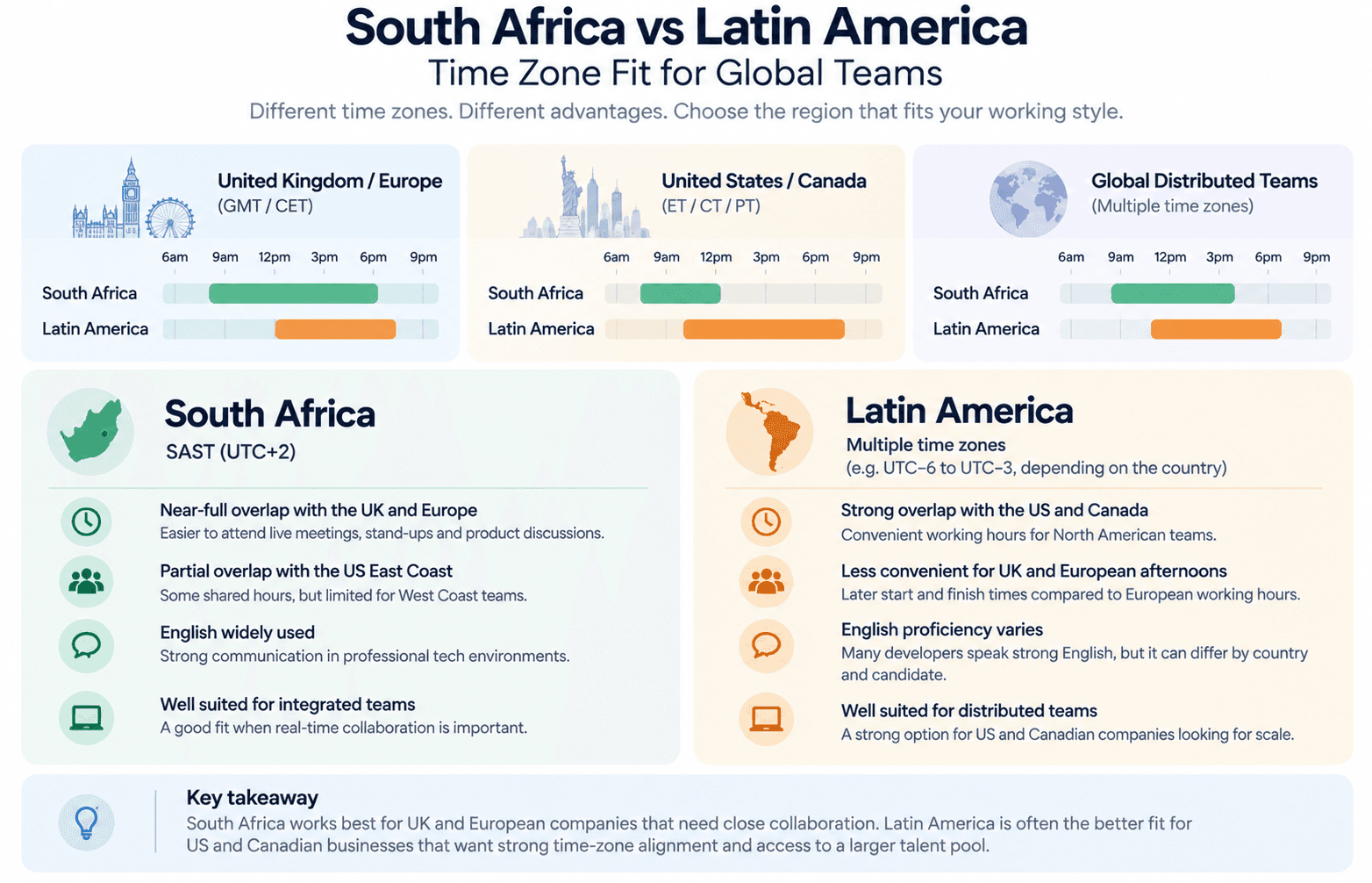
The best time-zone match depends heavily on where the employer is based.
South Africa follows SAST, or UTC+2, throughout the year. This gives developers almost complete working-day overlap with companies in the UK and continental Europe. They can normally attend stand-ups, planning sessions, reviews, customer calls, and other meetings during standard business hours.
Latin America is much better aligned with North America. Mexico, Colombia, Brazil, Argentina, and Chile all provide useful overlap with US and Canadian teams, although the exact difference depends on the country and time of year.
Language is another consideration. English is widely used in South Africa’s professional and technology sectors. Latin America also has many developers with strong English skills, especially those with international experience, but proficiency can vary more between countries and candidates.
When to Choose South African Talent
South Africa may be a better fit when:
Your company is based in the UK or Europe.
Developers need to work during European business hours.
Clear spoken and written English is a high priority.
New hires will work closely with an existing internal team.
You prefer to recruit from one national market rather than compare several countries.
Live meetings and day-to-day collaboration are an important part of the role.
Latin America may be the stronger choice for US and Canadian companies that want close time-zone alignment and a larger selection of national markets.
Conclusion
South Africa and Latin America both offer experienced developers at competitive costs, but they suit different types of employers.
Latin America provides a large and varied talent pool with working hours that align particularly well with North America. However, each country needs to be assessed separately because salaries, languages, employer costs, and hiring conditions vary across the region.
South Africa is smaller, but it can offer a simpler hiring market, strong English communication, and excellent working-hour overlap with the UK and Europe.
The right decision depends on more than salary. Companies should compare the full employment cost, available skills, communication needs, time-zone overlap, and how closely each developer will need to work with the existing team.
FAQs
Is South Africa a good alternative to Latin America for developer hiring?
Yes. South Africa can be a strong alternative for UK and European companies that need English-speaking developers who can work closely with their teams during the same business hours.
Which region has better time-zone overlap for remote developers?
South Africa generally offers better overlap with the UK and Europe. Latin America usually provides better working-hour alignment for companies in the US and Canada.
Which Latin American countries are best for hiring software developers?
Brazil, Mexico, Argentina, Colombia, and Chile are common choices because they have established technology hubs and experienced developer communities. The best country will depend on the required skills, budget, language needs, employment costs, and the employer’s time zone.

Find Your Next Talent
Hire South Africans in Days not Weeks, and only pay after 4 weeks
Or schedule a call with Bojan.