Software Development Outsourcing in South Africa: What to Know
8 min read


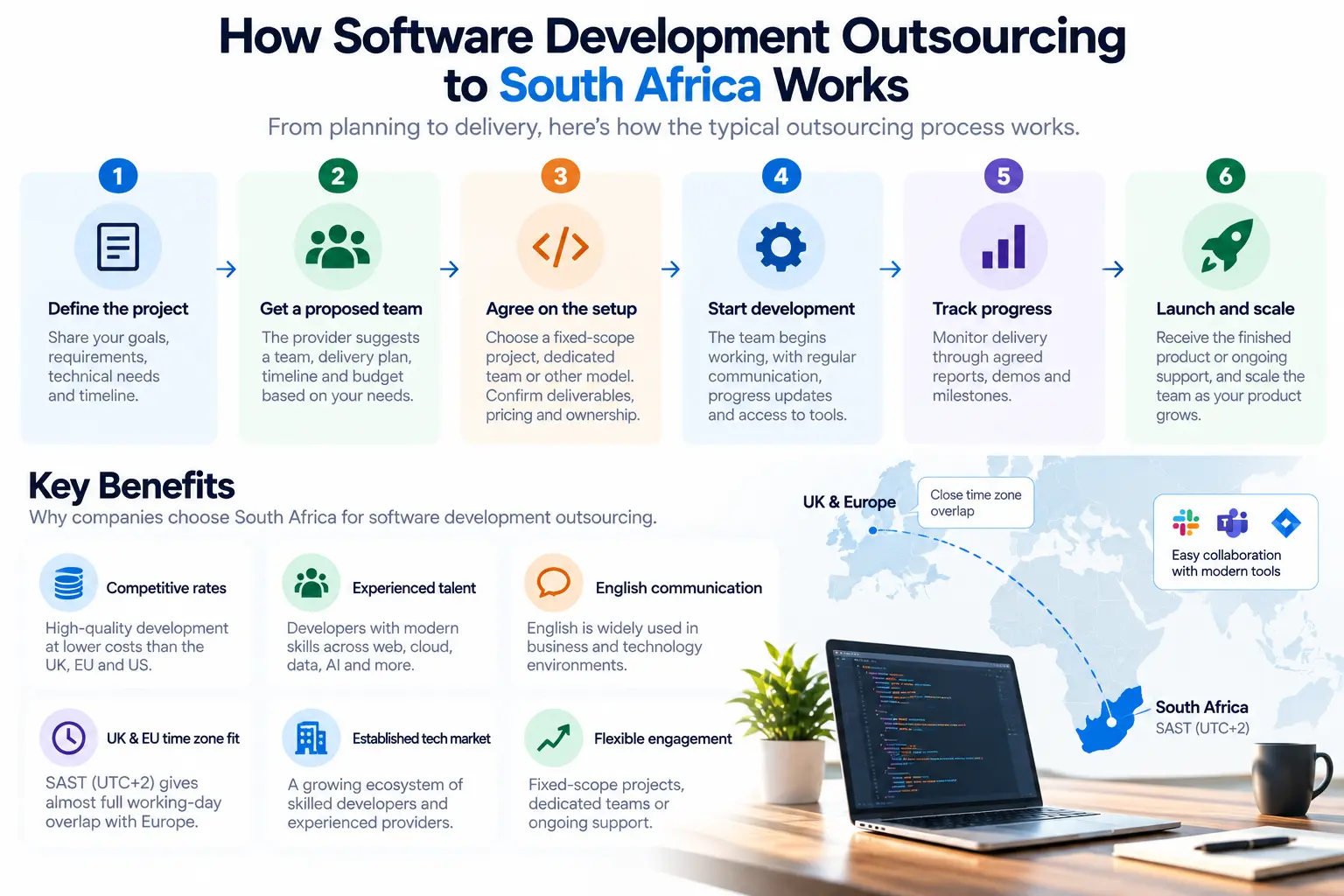
Building software with an internal team is not always the quickest or easiest option. A company may not have the right technical skills, may need more development capacity, or may want to launch a product without spending months hiring permanent employees.
Software development outsourcing allows an external provider to manage some or all of the development work. The provider may deliver a complete project, manage one part of a product, or supply an ongoing team for development and maintenance.
South Africa is becoming a popular option for this work. It offers experienced developers, competitive rates, widespread use of English, and working hours that align well with the UK and Europe.
Why Companies Outsource Software Development to South Africa
One of South Africa’s main strengths is its technical talent. Developers in the country work with JavaScript, Python, Java, .NET, cloud infrastructure, DevOps, data engineering, cybersecurity, mobile development, and other widely used technologies.
Software development is also an important area for skills development. The MICT SETA’s 2025-2030 Sector Skills Plan includes software developers among South Africa’s priority technology occupations.
Lower costs are another reason companies choose South Africa. Development rates are generally more affordable than equivalent rates in the UK, Western Europe, and the US. This can help a company build a larger team or hire more experienced developers without increasing its budget as much.
Communication is usually straightforward because English is widely used in South African business and technology. The country follows SAST, or UTC+2, throughout the year, giving teams almost a full working day of overlap with the UK and continental Europe.
Things You Need to Know About Software Development Outsourcing in South Africa
Outsourcing can reduce the pressure of recruitment and give a company faster access to technical skills. However, it also changes how the project is managed. Both sides need to understand who controls the work, how decisions will be made, and what the provider is responsible for delivering.
How the Outsourcing Model Works
The process usually starts by defining the project. The client explains the business problem, required features, technical needs, deadlines, and expected results. The provider then suggests a suitable team, delivery plan, budget, and way of working.
With a fixed-scope project, the outsourcing provider takes responsibility for most of the delivery. It manages the developers, organises the work, and delivers the agreed product or features by a set deadline.
A dedicated-team model works differently. The provider supplies a team that works on the client’s product over a longer period. The client usually stays involved in planning and setting priorities, while the provider manages staffing, performance, and daily delivery.
Responsibilities should be agreed before development starts. The client may control the product strategy, budget, and final approvals, while the provider manages the technical work and development team. Both sides should record the deliverables, deadlines, payment terms, ownership, and process for handling changes in a clear statement of work.
Regular communication is also important. Everyone should know who approves decisions, who receives progress reports, and who takes responsibility when a problem affects the schedule.
How Much Does Software Development Outsourcing Cost in South Africa?
The cost of outsourcing depends on the developers needed, the size of the team, the technical difficulty of the project, and how long the work will continue.
Public listings commonly place South African software development services between $25 and $49 per hour. Providers with specialist experience may charge between $50 and $99 per hour or more. These figures are general market benchmarks rather than guaranteed project prices.
The 2026 outsourcing rate guide from DECODE places South African software-engineer rates at approximately $25-$45 per hour. Solution architects may cost around $40-$65 per hour, while project managers may charge between $30 and $55.
A provider’s quote may cover more than the developers’ time. Depending on the project, the price may also include:
Technical planning and architecture
Project management
UI and UX design
Quality assurance and testing
DevOps and cloud infrastructure
Security reviews
Meetings and progress reports
Maintenance after the product launches
The cheapest team is not always the most cost-effective option. A team made up mainly of junior developers may have a lower hourly rate, but it may need more supervision and take longer to complete difficult work. A smaller team of senior developers may charge more per hour but deliver complex features faster and require less rework.
The contract model also affects the final price. A fixed-price agreement provides more certainty when the scope is clear, although any changes may lead to additional charges. A time-and-materials contract gives the company more flexibility, but the total cost can be harder to predict. A monthly dedicated team is often more suitable for ongoing product development.
Companies should therefore compare the full proposal, the experience of the team, and everything included in the price instead of choosing a provider only because it offers the lowest hourly rate.
Communication, Time Zones, and Team Collaboration
South Africa’s time zone is especially useful for UK and European companies. South African developers are one or two hours ahead of the UK, depending on daylight saving time, and usually share most of the working day with European teams.
This overlap makes it easier to hold daily stand-ups, planning sessions, product reviews, and problem-solving calls without asking either team to work unusual hours.
English is widely used in professional settings, but companies should still assess the communication skills of the people who will work on the project. Developers may need to explain technical risks, question unclear requirements, or communicate directly with product managers and other stakeholders.
Teams commonly use Slack or Microsoft Teams for communication and Jira, ClickUp, or similar platforms to manage tasks. The exact tools matter less than having an agreed process.
The client should know how often reports will be provided, what information they will include, and how urgent issues will be raised. A clear escalation process prevents small problems from remaining hidden until they affect the budget or delivery date.
What to Look for in a South African Outsourcing Partner
The provider’s technical experience should match the needs of the project. A company may be skilled in general web development but have limited experience with fintech, healthcare, enterprise software, AI, or another specialist area.
Ask for examples of similar projects and speak with previous clients when possible. Useful case studies should explain what the provider delivered, which technologies the team used, what problems it faced, and what results the client achieved.
Pricing should also be easy to understand. The proposal should clearly explain whether design, testing, project management, cloud infrastructure, and ongoing maintenance are included in the quoted price or charged separately.
Project ownership needs to be agreed before development starts. The contract should cover intellectual-property rights, access to the source code, data protection, confidentiality, security responsibilities, and what will happen to the project if the working relationship ends.
Good project management is just as important as technical skill. The provider should have a clear process for planning work, tracking progress, handling changes, reporting risks, and resolving problems before they affect the delivery date.
The right arrangement also depends on how much responsibility the provider should take. Understanding the differences between staff augmentation and managed services can help a company decide whether it only needs extra developers for its internal team or wants an external partner to manage delivery.
When Software Development Outsourcing Makes Sense
Outsourcing can be a good choice when a business does not have the internal team required to deliver a project. It can also help when specialist knowledge is needed for cloud migration, data engineering, cybersecurity, mobile development, AI, or another technical area.
The model works particularly well when:
The project or product function can be clearly defined.
The provider is expected to take responsibility for delivery.
The company needs to start development quickly.
Recruiting a permanent internal team would take too long.
The required skills are only needed for a specific period.
The company wants to increase delivery capacity without managing every developer directly.
For longer-term product development, working with a dedicated development team can provide more continuity than moving between short projects and temporary contractors.
Outsourcing may be less suitable when requirements change daily, key decisions cannot be made quickly, or the company is unwilling to give the provider access to the information needed to complete the work.
Conclusion
Software development outsourcing in South Africa can give companies quicker access to technical skills, lower costs than many Western markets, and working hours that align closely with the UK and Europe.
However, the results depend on how the partnership is organised. The project needs a clear scope, a realistic budget, defined responsibilities, regular communication, and an agreed process for managing changes and reporting risks.
Before choosing a partner, companies should review its technical experience, project-management process, pricing, security standards, and previous results. They should also decide whether they want the provider to take responsibility for delivery or simply add developers to an internally managed team.
When both sides understand their responsibilities and communicate regularly, a South African outsourcing provider can become a dependable long-term part of the company’s development process.
FAQs
Why outsource software development to South Africa?
South Africa offers experienced developers, competitive costs, widespread use of English, and strong working-hour overlap with the UK and Europe. Many providers also have experience working with international clients.
How much does software development outsourcing cost in South Africa?
Public 2026 benchmarks commonly place software development rates between approximately $25 and $49 per hour. Specialist developers, solution architects, and experienced providers may charge more. The final cost depends on the team, project complexity, contract model, and services included.
What is the difference between outsourcing and staff augmentation in South Africa?
With outsourcing, the provider normally manages the team and takes responsibility for delivering an agreed project or product function. With staff augmentation, external developers join the client’s existing team and remain under the client’s day-to-day management.

Find Your Next Talent
Hire South Africans in Days not Weeks, and only pay after 4 weeks
Or schedule a call with Bojan.