5 Mistakes Companies Make When Hiring South African Developers
8 min read


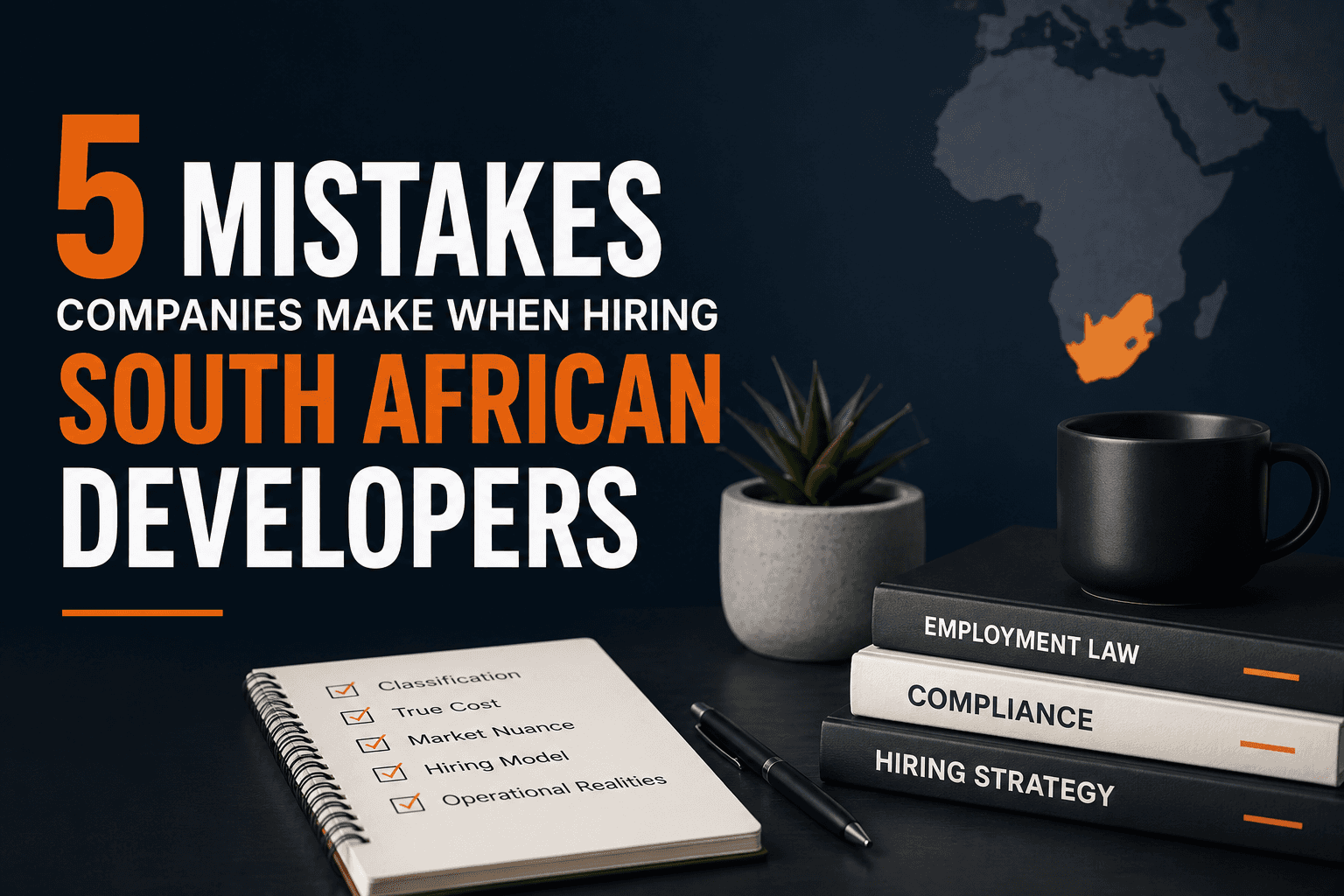
South Africa has become one of the most talked-about markets for remote developer hiring. The combination of native English, EU-aligned hours, and a massive developer pool is what makes it an attractive choice for tech companies. But as more foreign companies enter the market for the first time, the same avoidable mistakes keep coming up.
The assumption that hiring in Johannesburg works like hiring in London or New York is one of the most expensive errors a tech business can make. South African labour law is employee-protective, misclassification costs can add 30–40% on top of base salary, and the market moves faster than most companies expect.
Key Takeaways
Classification: Treating a full-time developer as a contractor is the most common and most costly mistake in this market.
True cost: Budget 25–35% above base salary for the loaded cost of a South African employee.
Speed: The best candidates move quickly. A slow hiring process will cost you the person you wanted.
Why Hiring South African Developers Trips Up Foreign Companies
South Africa looks like an easy hire on paper. The language is English, the time zone works for European teams, and the business culture is familiar. That surface-level ease is exactly what catches companies off guard.
South African labour law is employee-protective, especially compared to US employment law, and is much closer to European standards. The Basic Conditions of Employment Act (BCEA) and the Labour Relations Act (LRA) give employees strong statutory protections from day one. Workers who feel those protections have been violated can take their case to the CCMA (Commission for Conciliation, Mediation and Arbitration), and many do. Foreign companies used to US-style at-will employment often find this out the hard way.
The most common mistake is classification: engaging someone as a contractor when South African law sees them as an employee. Other patterns show up regularly too: salary misreads that ignore the loaded cost of employment, infrastructure surprises, and processes that move too slowly for a competitive market.
The Most Common Mistakes Companies Make When Hiring South African Developers
These are the mistakes that come up repeatedly when foreign companies hire in South Africa for the first time.
Misclassifying Contractors as Employees
This is the lead mistake, and also the most expensive. South African courts and the CCMA do not look at what the contract says, they look at the reality of the working relationship. If a developer works set hours, attends daily standups, has a single client, and uses company equipment, that looks like employment. The dominant impression test applies regardless of what the agreement is called.
If the arrangement is found to be employment, the consequences stack up quickly. SARS can impose penalties ranging from 10% to 200% of unpaid tax, on top of retroactive PAYE, UIF, and SDL contributions.
The developer can also claim full employment rights retroactively, including back pay for leave and protection against unfair dismissal. Getting the contractor vs employee distinction right with South African law before you structure any engagement here should be top priority.
The fix is straightforward: use an Employer of Record (EOR) for full-time roles, or make sure the contractor arrangement genuinely operates like one. If the developer works only for you, follows your schedule, and is integrated into your team, a contractor agreement will not protect you.
Underestimating the True Cost of a South African Developer
Base salary is not what a South African employee costs. Companies that budget only for the headline number consistently end up over budget once the full picture comes into view.
The loaded cost of a South African employee runs 25–35% above base salary once statutory contributions and market-standard benefits are factored in.
Here is what sits above the line:
UIF contributions run at 1% from the employer and 1% from the employee, deducted at source.
SDL (Skills Development Levy) is 1% of payroll for companies with an annual wage bill above R500,000. It is frequently missed in initial budgeting.
Medical aid and provident fund contributions are not legally mandated but are standard expectations in the South African tech market, particularly at mid and senior levels. Most employers contribute toward private healthcare and retirement funds as part of a competitive package.
The 13th cheque is not a legal requirement but is common at senior levels in South African tech. Candidates will often ask about it, and declining to offer it puts you at a disadvantage in competitive hiring.
Recruiter or staffing partner fees for direct hires typically run at 15–25% of first-year salary. If you are using a nearshore staffing partner or EOR, their margin sits on top of the rate instead.
The actual cost to hire a developer in South Africa varies significantly by seniority, stack, and hiring model, so make sure to budget the loaded cost from the start, not after the offer is made.
Treating South Africa as a Single Market
South Africa is not one hiring market. Cape Town, Johannesburg, Stellenbosch, Pretoria, and Durban have different talent concentrations, different rate expectations, and different specialisations.
For example, Cape Town skews toward SaaS and product engineering. Johannesburg is the largest market and the finance and enterprise capital. Stellenbosch is university-driven and strong in fintech. Pretoria and Durban are more cost-efficient and stronger in infrastructure and systems engineering.
Companies that hire well in South Africa treat these as distinct markets and target their approach accordingly. Companies that do not end up with a shallow candidate pool and wonder why the market is not delivering. Understanding where the talent sits before hiring developers from South Africa is one of the most practical things to get clear on before you start sourcing.
Choosing the Wrong Hiring Model
There are four main ways to hire a South African developer, and choosing the wrong one creates compliance risk, unnecessary overhead, or both.
Direct contractor hire is the fastest way to start but carries misclassification risk if the arrangement resembles employment. Best for project-based, time-limited work.
Employer of Record (EOR) is the most practical model for full-time hires without a local entity. The EOR employs the developer, handles payroll, tax, UIF, and compliance, and the developer works as part of your team. Most international companies hiring their first South African developers should start here.
Local entity setup gives you the most control and the lowest per-hire cost at volume, but it requires registering a South African business with the CIPC (Companies and Intellectual Property Commission) and setting up payroll. This is not the right call for a first or second hire.
Nearshore staffing partner manages the employment relationship, vetting, and compliance, and delivers pre-screened candidates. You pay a margin on the rate but save significantly on sourcing time and admin.
Choosing based purely on upfront cost, without accounting for compliance risk or operational overhead, is where most companies go wrong.
Ignoring South Africa-Specific Operational Realities
Generic hiring advice does not cover this, but it matters.
Load-shedding has been a real issue in South Africa, though the situation has improved substantially. It is still worth asking any candidate about their home office setup. Most senior developers working for international companies have backup power, fibre, and LTE failover in place.
The public holiday calendar does not align with European or US schedules. South Africa has 12 public holidays per year, several of which fall at different times to UK or EU equivalents. Factor this into sprint planning.
Moving too slowly with strong candidates is one of the most common ways companies lose the hire they wanted. A drawn-out process (multiple interview rounds stretched over weeks, slow feedback loops, offers that take too long to land) will cost you the person. First interview to offer in under three weeks is a reasonable target.
Underestimating English fluency variance is a subtler one. English is the first language of business in South Africa, but fluency and communication style vary across candidates. A developer who writes excellent code may not be the right fit for a client-facing or highly collaborative role. Screen for both communication style and technical skill.
Skipping reference checks is a mistake in any market, but it costs more in South Africa because the cultural expectation around references is strong. A candidate who cannot provide references or who is evasive about them is a red flag worth taking seriously.
What Hiring South African Developers Right Looks Like
Companies that hire well in South Africa share a few common patterns.
They classify correctly from day one: using an EOR or local entity for full-time roles, not stretching a contractor agreement to cover what is functionally employment.
They budget the loaded cost into role planning from the start. The 25–35% above base is built into the hiring plan before the search begins.
They differentiate by city and segment, not by country. Cape Town is not Johannesburg, and the approach to sourcing should reflect that.
They move fast on strong candidates. First interview to offer in under three weeks. The best candidates have options, and a slow process signals that working with you will be slow too.
They build infrastructure questions into screening. Backup power, fibre connection, home office setup: these are standard questions, not intrusive ones.
Conclusion
Hiring in South Africa can deliver exactly what it promises: strong technical talent, real time zone alignment, and meaningful cost savings compared to US or UK equivalents. But those outcomes depend on getting the fundamentals right from the start.
The companies that struggle are almost always the ones that moved too fast without understanding the market, underestimated the compliance requirements, or treated South Africa as a single talent pool rather than a collection of distinct hiring environments.
Working with a local recruiter, EOR, or staffing partner who knows the South African labour landscape removes most of that risk. Trying to navigate BCEA, LRA, and SARS obligations from abroad without local support is where most compliance problems start.
Get in touch and we can help you get the structure right before you make the hire.
FAQs
What is the most expensive mistake when hiring developers in South Africa?
Misclassification is the most expensive mistake by a significant margin. Treating a full-time developer as an independent contractor when the working arrangement looks like employment can result in back taxes, penalties, retroactive UIF contributions, and CCMA claims. The additional cost can reach 30–40% on top of base salary once everything is factored in.
Can I hire a South African developer as a contractor if they work full-time for me?
Technically yes, but practically it creates serious risk. If the developer works exclusively for you, follows your schedule, attends your standups, and uses your tooling, South African courts and the CCMA will likely find that the arrangement is employment under the dominant impression test, regardless of what the contract says. For full-time roles, an EOR is the cleaner and safer structure.
How do I avoid misclassification risk when hiring in South Africa?
The safest route is to use an Employer of Record for any role that looks like full-time employment. If you are using a contractor structure, make sure the arrangement genuinely operates like one: the developer works for multiple clients, sets their own hours, and is not integrated into your team in a way that resembles employment. Getting local legal or EOR support before you make the hire is the most reliable way to get this right.

Find Your Next Talent
Hire South Africans in Days not Weeks, and only pay after 4 weeks
Or schedule a call with Bojan.