South Africa vs India for Developers: A Hiring Comparison
8 min read


Key takeaways
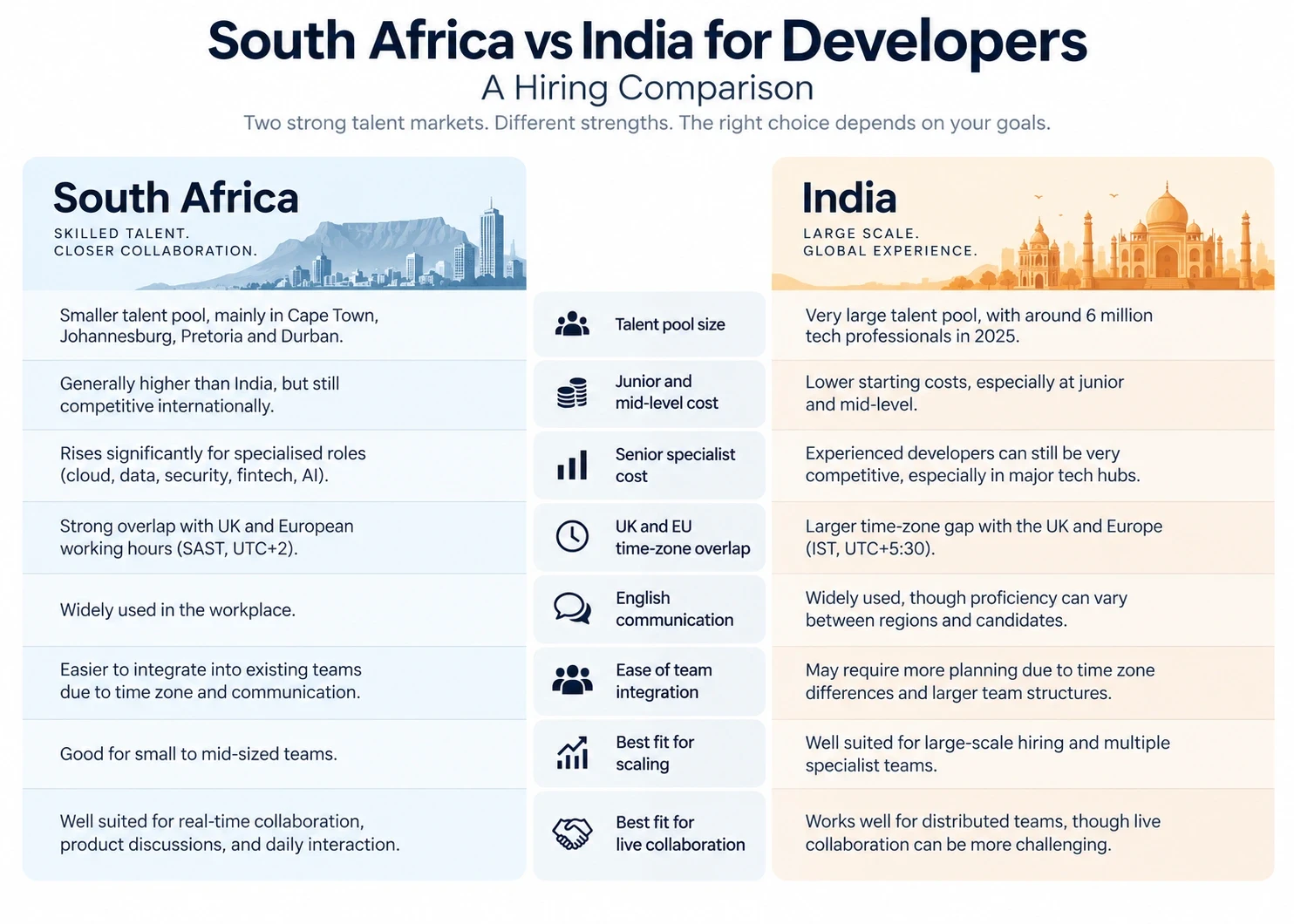
India offers far greater scale. Its technology industry employs roughly 6 million professionals, giving companies access to one of the largest technical workforces in the world.
South Africa generally costs more at junior and mid-level, but its overlap with UK and European working hours can make developers easier to integrate into an existing team.
Salary is only one part of the comparison. Recruitment fees, statutory contributions, benefits, contractor premiums, EOR fees, equipment, and management overhead all affect the actual cost of hiring.
India is often stronger when the priority is low-cost scale. South Africa can be the better fit when live collaboration, English communication, and closer day-to-day integration matter more.
South Africa and India are both well-established hiring markets for companies that want to find software developers outside the UK, Western Europe, or the US.
India has a much larger technology workforce and a longer history as a global outsourcing destination. Data from India’s Ministry of Electronics and Information Technology shows that the country’s IT and IT-enabled services sector is expected to employ around 6 million professionals in FY2025-26. This gives employers access to a large number of developers with different experience levels, technical skills, and areas of specialisation.
South Africa does not have the same workforce size as India, but it offers a different set of benefits. Communication is generally straightforward, working hours align closely with the UK and Europe, and developers can work directly with an existing internal team instead of operating as a separate offshore department.
The main question is not just, “Which country has cheaper developers?” Companies should also consider where they can find the right skills, hire suitable candidates, manage total costs, and build a strong working relationship with their remote team.
Why Companies Compare South Africa and India for Developer Hiring
Both countries offer lower developer costs than many Western markets. They also have established remote-working practices and developers with experience in JavaScript, Python, Java, .NET, React, cloud engineering, data, DevOps, mobile development, and other widely used technologies.
The main difference between the two countries is the size of their talent pools and how easily developers can become part of an existing team.
India has decades of outsourcing experience and a very large supply of technical talent. Research from NASSCOM shows that the country’s technology workforce reached approximately 5.8 million people in 2025. More than 2 million of these professionals were part of India’s digital talent pool.
This makes India a good choice for companies that need to hire many developers, build several delivery teams, or find candidates with a specific and less common technical skill.
South Africa has a smaller candidate pool, mainly concentrated in Cape Town, Johannesburg, Pretoria, and Durban. However, it can be a particularly good fit for UK and European employers that want developers to attend live meetings, take part in product discussions, and work closely with their internal staff throughout the day.
If the main goal is to increase engineering capacity, these practical differences can be just as important as the salary offered to each developer.
Things You Need to Know About South Africa vs India Developer Costs
Comparing developer costs in South Africa and India requires more than looking at one national salary average. Seniority, technical skills, location, employment type, and additional employer expenses can all change the final cost. It is best to begin with a broad side-by-side comparison before looking at each factor in more detail.
Developer Costs at a Glance
The following figures are salary benchmarks rather than guaranteed hiring prices. Actual offers will depend on the city, technology, experience, company, and employment arrangement.
Cost area | South Africa | India |
Junior developer salary | Roughly R15,000-R38,000 per month | Approximately ₹600,000-₹1,200,000 per year for software engineers with 0-3 years |
Mid-level developer salary | Roughly R23,000-R60,000 per month | Approximately ₹1,200,000-₹2,500,000 per year for software engineers with 3-7 years |
Senior developer salary | Commonly R59,000-R100,000+ per month in stronger-paying roles | Approximately ₹2,500,000-₹6,000,000 per year across the 7-15-year brackets |
Contractor rates | Usually higher than an equivalent monthly employee salary and highly dependent on scarcity and contract length | Often competitive, but senior contractors working for international clients may charge well above local employee benchmarks |
Employer costs | Payroll administration, benefits, statutory contributions, equipment, recruitment, and possible EOR fees | Provident-fund obligations where applicable, gratuity, insurance, benefits, payroll administration, recruitment, and possible EOR fees |
Main cost advantage | Competitive international pricing combined with European-hour collaboration | Lower entry-level costs and a much larger talent pool for scaling |
Note: The Indian salary ranges come from Adecco’s 2025 India Salary Guide. Its software-engineer benchmark rises from ₹600,000-₹1,200,000 for zero to three years of experience to ₹4,000,000-₹6,000,000 for developers with ten to fifteen years.
South African benchmarks cover a broad range because sector and specialisation make a substantial difference. Fintech, cloud, data, security, and AI roles can sit well above general web-development salaries. OfferZen’s latest research also reports that senior developers are seeing stronger salary growth than other experience groups.
How Developer Salaries Compare
India will usually look cheaper at junior and mid-level when salaries are compared directly. That does not mean every Indian developer is inexpensive.
Experienced engineers in Bengaluru, Hyderabad, Mumbai, Pune, Delhi NCR, and other competitive hubs can command considerably higher packages, especially in AI, data engineering, cybersecurity, cloud infrastructure, and product development.
South Africa follows a similar pattern but on a smaller scale. A junior developer working in general web development may be comparatively affordable, while a senior cloud architect or fintech engineer can cost several times as much.
Location affects both markets. Cape Town and Johannesburg may price above smaller South African cities, just as Bengaluru and Mumbai can differ from India’s regional markets. A national average is useful for initial planning, but it is not a substitute for benchmarking the actual role.
The Salary Is Not the Full Hiring Cost
Base salary is only the first line of the budget. Recruitment fees, payroll administration, statutory costs, private medical cover, retirement contributions, equipment, onboarding, currency conversion, international payments, and employee replacement all affect total hiring cost. A contractor may also charge a premium to cover unpaid leave, insurance, tax administration, and the uncertainty of project-based work.
In India, eligible employers and employees commonly contribute to the Employees’ Provident Fund. The standard contribution is 12% of applicable wages from each side, although coverage and calculation rules need to be checked for the individual arrangement.
International companies also need a compliant way to engage talent. An overview of the EOR model can help clarify when it makes sense to employ someone without establishing a local entity. The EOR fee increases the headline cost but can remove a substantial amount of payroll, tax, and employment-administration work.
A cheaper salary can therefore produce a more expensive operating model if the team requires extra management, repeated replacement hiring, or long delays between meetings and decisions.
Talent Availability and Competition
India has a clear advantage when it comes to the size of its technology workforce.
The country’s talent range supports major outsourcing providers, multinational technology centres, start-ups, consulting firms, and software product companies. Employers can search for candidates across many cities and established technology hubs. This makes India particularly useful for businesses that need to hire several developers, build multiple teams, or find people with specific technical skills.
However, a larger talent pool also means more competition between employers. Experienced developers often receive offers from local product companies, global capability centres, outsourcing providers, and international businesses. Hiring and retaining these professionals may require higher salaries, clear opportunities for career growth, and more challenging technical work than the lower salary benchmarks suggest.
South Africa has a smaller technology market, which can make highly specialised or senior developers harder to find. At the same time, employers only need to understand one national employment market. This may be simpler than comparing salaries, hiring conditions, and talent availability across India’s different cities, states, and technology hubs.
For a company planning to build a dedicated development team for the long term, the quality, suitability, and stability of the available candidates may be more important than the total size of the country’s workforce.
Time Zone, Communication, and Team Integration
South Africa follows South Africa Standard Time, or SAST, which is UTC+2 throughout the year. This gives South African developers almost a full working day of overlap with teams in the UK and most of continental Europe.
India follows India Standard Time, or IST, which is UTC+5:30. India is three and a half hours ahead of South Africa. It is also four and a half hours ahead of the UK during British Summer Time and five and a half hours ahead during the UK winter.
Developers in India can still attend stand-ups, planning sessions, and other meetings with European teams, especially when calls are arranged in advance. However, the time difference can become more difficult when developers need to join unexpected afternoon calls, speak with customers, work in live pairing sessions, or communicate regularly with a UK-based product team throughout the day.
English is widely used in the technology sectors of both countries. Even so, employers should assess each candidate’s communication skills during the hiring process. This is especially important for positions that involve customer conversations, product planning, team leadership, or writing detailed technical documents.
Whether a company uses direct employment, staff augmentation, or a wider offshore software development model, successful integration requires clear responsibilities, a well-organised onboarding process, access to the right information, and full involvement in the company’s engineering culture.
When to Choose South African Talent
South Africa may be the better fit when:
Strong overlap with UK or European working hours is important.
Developers need to participate in live meetings and product decisions.
Spoken and written English communication is a priority.
You want internationally competitive costs without a large time-zone gap.
You are building a closely integrated team rather than a separate delivery centre.
India may be stronger when scale and the lowest possible starting cost are the main priorities. South Africa becomes particularly competitive when collaboration, communication, and reduced management friction are included in the calculation.
Conclusion
There is no universal winner in the South Africa vs India developer costs comparison.
India gives employers access to a vastly larger technology workforce and often lower junior and mid-level salary benchmarks. It is a natural option for companies that need scale or want to tap into a mature outsourcing ecosystem.
South Africa offers a smaller pool, but its European-hour overlap and ease of day-to-day communication can make remote developers feel more like part of the internal team.
The right comparison is not simply salary against salary. It is the total cost of finding, employing, integrating, and retaining the developers who can do the work well.
FAQs
Is South Africa a good alternative to India for hiring developers?
Yes. South Africa can be a particularly good alternative for UK and European companies that value working-hour overlap, English communication, and direct integration with an existing product or engineering team.
How much does it cost to hire a developer in South Africa?
Broad monthly salary benchmarks range from approximately R15,000-R38,000 for junior developers to R59,000-R100,000 or more for experienced senior specialists. Employer costs, benefits, recruitment, and the engagement model need to be added separately.
How much does it cost to hire a developer in India?
Adecco’s 2025 guide places software engineers at approximately ₹600,000-₹1,200,000 per year for zero to three years of experience. Its benchmark rises to ₹2,500,000-₹4,000,000 for seven to ten years and ₹4,000,000-₹6,000,000 for ten to fifteen years.

Find Your Next Talent
Hire South Africans in Days not Weeks, and only pay after 4 weeks
Or schedule a call with Bojan.